

News

Integrity Health Cuts the Ribbon on Partnership Health Center in Brick

Integrity Health Cuts the Ribbon on Partnership Health Center in Brick 789 444 DMR Architects

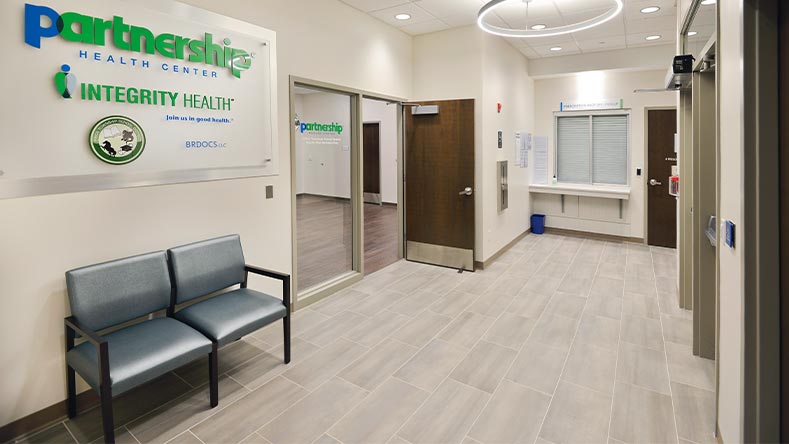
On March 2 Integrity Health cut the ribbon on their newest Partnership Health Center, an on-site healthcare office, at the Warren H. Wolf Elementary School in Brick.

DMR designed the project in approximately 7,000 square feet, converting five existing classrooms and connecting corridor spaces into a new Partnership Health Center, an on-site healthcare office where members of the board of education can receive primary care, pharmacy, laboratory and physical therapy services in one location. The space includes general exam rooms, a procedure room, X-Ray equipment, lab and blood draw, pharmacy, physical therapy, behavioral health and staff support spaces and offices.

Founded by Doug Forrester, Integrity Health teams up with employers to find and renovate space in existing, employer-owned buildings for Partnership Health Centers, where members can receive routine medical services in one location. The services are provided without fees or deductibles and are available only to members and their dependents, resulting in convenient and fast routine medical services.

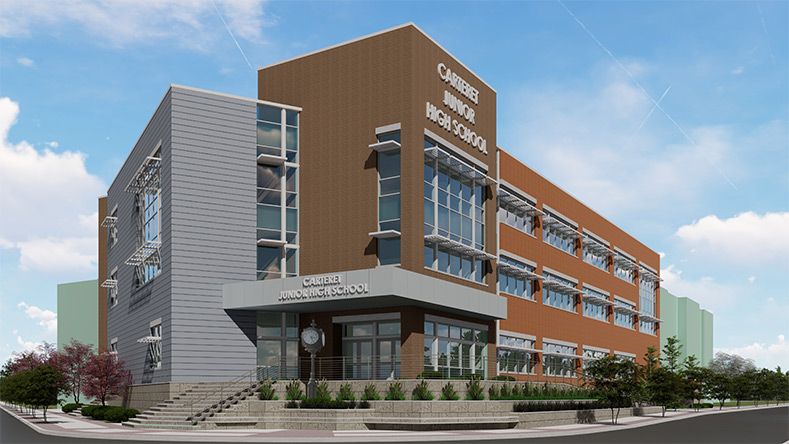
A rendering shows the exterior of the Carteret Junior High School, located on the corner of a main intersection.

Voters Approve Carteret Referendum Projects

Voters Approve Carteret Referendum Projects 789 444 DMR Architects

Voters in Carteret approved a $37 million referendum to fund renovations to each of the district’s facilities, and also construct a new, state-of-the-art Junior High School.

In preparation for the referendum, DMR worked closely with the town and the district to include projects at all schools in the funding, closely adhering to a strict budget to reduce the impact on taxpayers, and to provide schematic design services.

The proposed Junior High School is expected to educate approximately 600 seventh and eighth grade students. Completion of the project will allow for a reassignment and realignment, resulting in the three existing elementary schools serving pre-K-4; the existing middle school serving grades 5 and 6; the new junior high school serving grades 7 and 8; and the existing high school serving grades 9-12. In addition to addressing overcrowding, the construction of the new school will open up space to provide full day kindergarten and additional pre-K programs. The 60,000 SF school will be arranged in a departmentalized environment, with 24 classrooms, enhanced art and music education spaces, a think tank and STEM lab.

Renovations at each of the district’s five existing schools include upgrades to the high school auditorium and bathroom and HVAC and stair tower upgrades at multiple schools. 

Video Release Celebrates Building 3 Opening at The Grande at Metro Park

Video Release Celebrates Building 3 Opening at The Grande at Metro Park 789 444 DMR Architects
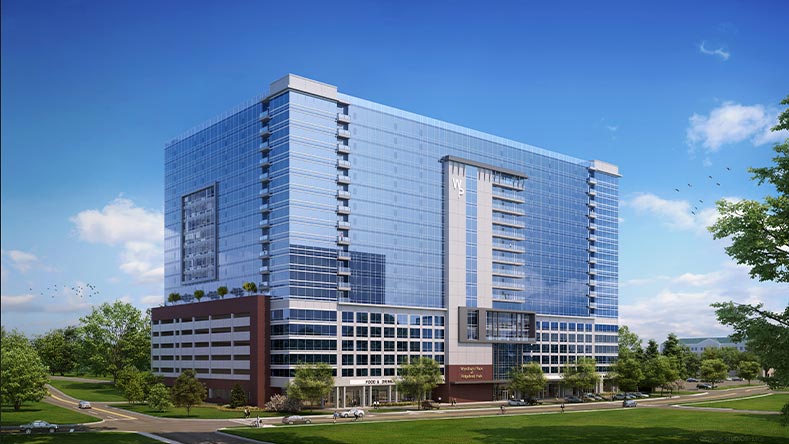
Tonight DMR will join the Township of Woodbridge and developers and residents of The Grande at Metro Park to celebrate the ribbon cutting of Building 3, the third of four buildings at the residential development which will ultimately be a 355-unit rental community. Today we are also celebrating the building’s opening with a video release highlighting a key feature of the development, its expansive amenity package.

Lloyd A. Rosenberg Honored with NJBIZ ICON Award

Lloyd A. Rosenberg Honored with NJBIZ ICON Award 150 150 DMR Architects

We are excited to share that our President & CEO, Lloyd Rosenberg, was among the honorees this week at the 2019 ICON Awards presented by NJBiz.

Lloyd is the driving force behind the phenomenal growth and success of DMR Architects, a firm with New Jersey roots, strong relationships with the business community and a passion for advancing the facilities and communities where we live. Lloyd founded the firm in 1991, and continues to lead the firm today as President & CEO.

When Lloyd founded DMR Architects, it was a three-person operation with no office, no staff and no clients. Originally committed to designing exclusively educational facilities, over the years, Lloyd steadily added expert talent and responsibly diversified the firm’s capabilities, resulting in a firm today that employs a staff of 40, consistently ranks among the top architectural firms in the state, provides a diverse range of services and completes an average of 100 projects a year across all market sectors. For its entire history, DMR has called northern New Jersey home, with all employees working from the office’s sole northern New Jersey location and the majority of the firm’s projects being located within the state.

Lloyd was a leading architect who enjoyed a more than 25-year, award-winning career with plenty of professional highlights prior to the founding of DMR. The physical environment of his professional work ranged from projects close to home to around the globe.

Despite a storied career prior to the firm’s founding, Lloyd’s greatest career accomplishments have come during the last 28 years, where he has grown DMR Architects into the team it is today, a thriving professional service firm that employs a uniquely qualified staff; architecturally serves all market sectors; and has also positioned itself as a leader in pioneering redevelopment planning and sophisticated sustainable design services. As part of a strategic and responsible diversification program, today the DMR team also includes professionals with backgrounds in economic development and community outreach, municipal government, real estate, project finance, engineering, and land use, as well as in-house general counsel, positioning the firm as a team that provides unparalleled services to its clients.

Lloyd has played a role in overseeing thousands of design and construction projects while leading DMR, a volume of work that represents hundreds of millions of dollars in construction. Among these projects are many that have had a great impact on the landscape of New Jersey, including the State’s first nature museum; the first school for the blind and the first LEED certified public school; Bergen County’s first brewery; the rail station that first brought train service to the Meadowlands; and the new Frank J. Gargiulo Campus, the $150 million vocational/technical high school in Hudson County, one of the most technologically-advanced schools in the country. The thousands of other projects completed under Lloyd’s direction include sophisticated healthcare facilities, elementary schools, luxury lofts, downtown master plans, police stations, parks, modern offices, academic facilities, sports complexes, renovations to an elementary school forced to close following Superstorm Sandy and construction oversight of the much-anticipated American Dream project.

Lloyd is involved and hands-on, with an everyday presence and involvement in the functions of the firm. He is a supportive leader dedicated to the professional growth of employees, empowering them to take on new responsibilities, expand their capabilities and immerse themselves in the business community, without fear of failure.

Mellone – Mariniello Recreation Center Opens

Mellone – Mariniello Recreation Center Opens 789 444 DMR Architects

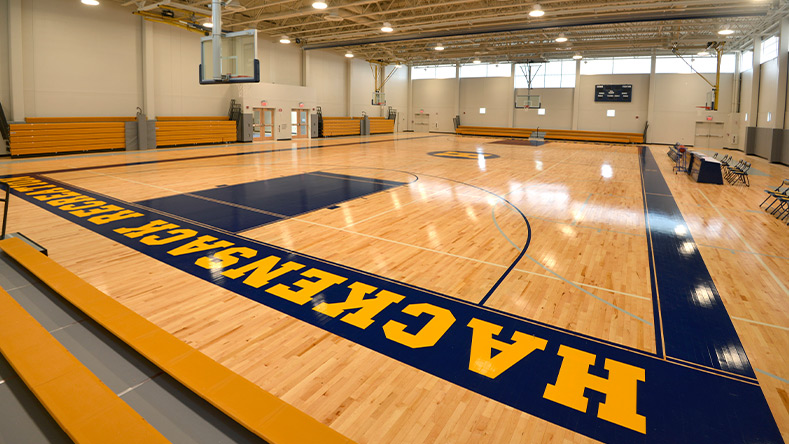
Today marks the first day of programs at the Mellone – Mariniello (M&M) Recreation Center in Hackensack, giving residents access to a recent redesign and expansion that addresses the community’s need for current athletic, meeting and activity space.

The project took an existing 8,000 square foot building and renovated and expanded the facility into a 22,000 square foot facility that now includes an expanded 400-seat basketball arena, a new senior center, a new lobby and three multipurpose rooms.

“DMR’s plans will allow us to host more athletic team practices and games, offer parents an after-school program for their elementary and middle school-aged kids, and give retired seniors a better location for classes and activities,” Mayor John Labrosse said.

“The 21st century community center is a destination where people can often spend several hours meeting with friends, learning new skills, and enjoying team sports all in one place,” said Lloyd A. Rosenberg, AIA. “Places like Hackensack are rethinking their current recreation spaces, not just for its residents’ needs now, but with flexibility to continue to meet these needs over the next generation of users.”

The facility also offers community meeting and classroom spaces, new restroom facilities, a snack bar, storage area, and an office for the center’s administration.

DMR Celebrates Opening of SB One Banking Center

DMR Celebrates Opening of SB One Banking Center 789 444 DMR Architects

On July 27 DMR joined SB One Bank, clients and the local community to celebrate the bank’s 14th New Jersey location and first banking center in Hudson County at The Avenue Collection luxury condominium complex at Port Imperial in Weehawken.

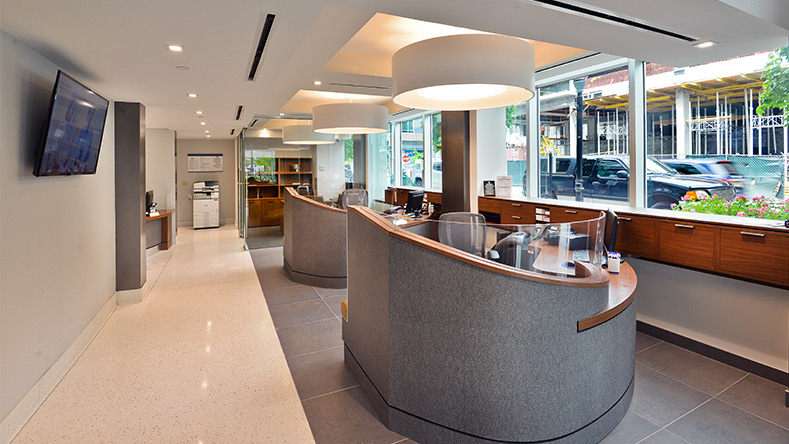
Following the bank’s rebranding in 2018, SB One Bank (formerly Sussex Bank) hired DMR to create the physical manifestation of SB One’s mission to provide a more personal banking experience without the separation by counters, desks and glass windows that are seen in more traditional banking layouts.

The new concept starts with an airy palette and includes half-moon booths in high end finishes to provide a luxury retail experience in a private and comfortable environment for customers providing personal information. The layout located the conference room at the corner of The Avenue at Port Imperial and City View Drive for meeting participants to enjoy SB One Bank’s view of the waterfront and New York City skyline.

“At SB One Bank, we understand that each customer’s needs are not only unique but they require a personal touch,” Vito Giannola, Senior Executive Vice President and Chief Banking Officer for SB One Bank, said. “This branch design allows us to embrace technology and integrate personalized service.”

Charles H. Sarlo

Charles Sarlo set to Join ExploreNJ Event

Charles Sarlo set to Join ExploreNJ Event 2000 1125 DMR Architects

DMR is proud to announce that Charles H. Sarlo, Esq. is set to join a panel at this week’s ExploreNJ, a special event designed to attract foreign investors to the state. More than 30 foreign entities looking to expand operations in the United States are expected to attend.

Co-sponsored by the Commerce and Industry Association of New Jersey and Choose New Jersey, the two-day event will take place on Thursday, June 13 and Friday, June 14. Events on Thursday will be focused on finance and commerce and will take place at New Jersey City University’s School of Business in Jersey City. Friday’s events, which will focus on innovation, technology, and entrepreneurship, will be hosted at the New Jersey Institute of Technology in Newark.

Charles is set to join the “Real Estate: Finding the Right Location” panel during Thursday’s finance and commerce portion. A 30-year veteran in New Jersey’s corporate and real estate landscape, he brings a unique perspective and professional background to the panel.

ExploreNJ is a spin-off event of the annual SelectUSA Investment Summit, an event hosted by the United States Department of Commerce that is already underway this week in Washington D.C. Other spinoff events are being hosted in dozens of locations across the country by local economic development organizations.

Frank J. Gargiulo Campus Awarded LEED Gold Certification

Frank J. Gargiulo Campus Awarded LEED Gold Certification 789 444 DMR Architects

The Frank J. Gargiulo Campus, the new, 350,000 square foot high school that opened its doors in September 2018, has achieved LEED Gold certification.

The vocational-technical high school is an icon for sustainability and will soon be awarded the LEED Project of the Year: Schools award from the United States Green Building Council New Jersey Chapter.

The building is equipped numerous sophisticated sustainable elements, such as wind turbines, geothermal heating, 27,000 square feet of solar panels and 20,000 square feet of green roofs, all of which helped the building achieve a total of 75 points.

The project was an intense collaborative effort and included a team of numerous professional services and construction firms, with DMR serving as the architect of record and LEED specialist.

New state law for public-private projects is an opportunity for design, construction firms

New state law for public-private projects is an opportunity for design, construction firms 960 540 DMR Architects

By Joshua Burd

A new state law could be a game-changer for municipalities, school districts and other government entities, allowing them to tap into private capital for new facilities or infrastructure.

It could also be transformative for New Jersey’s design and construction industry.

The law, which took effect in mid-February, expands the use of so-called public-private partnerships in the Garden State, allowing public entities and agencies to enter agreements with the private sector for building or infrastructure projects within their jurisdiction. As part of the arrangement, the private entity assumes the financial and administrative responsibility for the development, construction and other improvements tied to the project, while the public agency makes regular payments during the length of the agreement.

The agency or entity then assumes ownership at the end of the agreement period.

“This is the future,” said Lloyd Rosenberg, CEO and president of DMR Architects in Hasbrouck Heights. “This is a very important thing for our firm to embrace and to develop, so we’re putting all of that together to attract municipalities or counties to turn over some of their projects, instead of going the traditional way.”

The law also provides a new opportunity for companies like DMR that have experience with so-called design-build projects, a procurement method in which architects and contractors bid together from the beginning. Design-build, which allows for greater predictability and better efficiency, has long been a favorite of state agencies such as the Schools Development Authority, but could be more widely adopted under the public-private partnership law.

As Rosenberg noted, the statute allows for design-build procurement by municipalities, school boards and state agencies, but in an expanded form that also includes plans for financing and operating the project. That framework also allows towns and school districts to avoid voter referendums, which can derail large capital projects in spite of an overwhelming need.

And while the law still requires procurement, the public entity is not required to select the lowest bidder. That can minimize issues such as change orders and other delays.

“You eliminate the public referendum and you eliminate the low-bid contractor,” Rosenberg said. “And they are two of the obstacles that have always been in the way for many communities to get things done.”

The so-called P3 legislation, which Gov. Phil Murphy signed into law last summer, expands a popular law that has helped reshape several of the state’s college campuses in recent years. Public institutions such as The College of New Jersey, New Jersey City University and Montclair State University have partnered with developers to build new facilities on state-owned land, in an effort to modernize their campuses without added tuition hikes.

DMR is especially well-positioned to tap into the new statute. Its leadership team also includes Charles Sarlo, its general counsel, who is also vice chairman of the state Economic Development Authority and helped vet many higher education projects under the previous law. The firm’s director of business development, Colleen Mahr, is the longtime mayor of Fanwood and is the president of the New Jersey State League of Municipalities.

Real Estate NJ spoke with Rosenberg, Sarlo and Mahr recently about the opportunity with the new legislation.

Real Estate NJ: This is a long-awaited expansion of the 2009 law that helped so many state colleges and universities. Who else do you think will share in those benefits under the new statute?

Charles Sarlo: It’s counties, school districts, municipalities, improvement authorities, housing authorities, fire commissioners (if they’re independent). It’s very broad — it’s anything that has a public purpose that can be used by the public. So it’s not only vertical infrastructure. It’s the roads and the bridges, but it could also be parks, it can be libraries, school buildings. It could be a boiler replacement for a school — it could be as simple as that. Someone may even stretch it and say senior housing, if the senior housing has a public purpose for particular municipality. Like any new law, there’s gaps in the law that could be tested in the courts, so we’ll see.

RENJ: When it comes to expanding beyond the design-build concept, how important is the added component of a private-sector entity being responsible for financing and maintaining a project?

CS: The theory there is, if you’re a public entity looking to do a project and it’s the typical design-bid-build, you may have a certain budget that you want to fit in initially to keep your bond issuance down. But maybe the quality of the project to fit in that budget may get you through a 10-year life cycle.

If you’re now the PPP developer and design team and you have to actually build into your cost a 30-year lifecycle or a 20-year lifecycle — whatever the financing works out to be — you don’t want to build it and in 10 years, you have to replace that floor or that system or that roof, because the margin to replace it is going to be inherently higher than at the time of construction. If it costs you 10 percent more for a better product, you’re going to put that 10 percent more in rather than going back in year 10 or 11 and ripping off the roof and putting a new one on. So that’s where the value proposition comes into play.

RENJ: For local officials who are skeptical about these types of partnerships, how can you leverage the success that colleges and universities had under the 2009 law?

CS: If you’re a mayor and council, you probably did not pay attention to what went on there. So I think those are good case studies that, as we talk about it, we have to talk about the successes and the private investment that it brought and the fact that those projects probably would not have gotten done without the PPP process.

RENJ: Let’s look at it from a developer’s perspective. Is there a cluster of developers out there that are already comfortable with these types of public-private projects?

CS: There are national players out there that do PPPs. The minimum threshold right now for them to do a project is $50 million. Now, in New Jersey, a lot of the infrastructure that municipalities and counties have are not $50 million projects — a police station (for instance, costs) $10 to $12 to $14 million. So I think initially those national PPP developers are going to be interested, but they’re going to say the projects are not large enough for us. So it’s going to create a void for the New Jersey entities to come together and deliver these projects.

RENJ: Do you see the typical private developer in New Jersey, who is building office or retail space, getting into this sector?

CS: They really have to have a fundamental shift in their business model before they go into that. I almost see it as more of the design firms like DMR and engineering firms that are in the public sector joining with general contractors that are in the public sector and bringing the financing piece to the table. I see that to be the team because, interestingly, the PPP law doesn’t say ‘developer.’ It just says ‘business entity,’ so it kind of leaves it open.

RENJ: So you don’t necessarily need a traditional developer to take the reins here.

Lloyd Rosenberg: You need the elements — you need the contractor and you need the money. So that’s what we’re doing. We’re putting that together.

RENJ: So in that scenario, it’s technically the architect and the contractor that own the property and are taking care of the properties for the duration of the agreement. Is that something that the architects and contractors are really accustomed to?

CS: (It’s a question of) whether or not their business starts to include that piece or is that another player in the mix? And that’s all going to be shaking out as the law develops.

RENJ: Have you started to have those conversations with banks?

LR: We have banks and institutions that have said, ‘Call me when you’re ready.’ So we’re getting ready.

CS: And it doesn’t necessarily have to be a bank or a financial institution. Depending on the size of the project and the type of project, just like the Opportunities Zones, it could just be a group of individuals that want to make a return. It could be corporate money sitting on the sidelines. … If you’re a manufacturer of gym floors, you’ve got a lot of cash on your balance sheet and a new gym needs to be done — well, why not be part of the team to finance that gym? You’re going to get your product installed, it helps your overall business, you’re going to make a return on the cash that was sitting on your books. So there are very creative ways to be able to finance this.

RENJ: Colleen, your background as a mayor must be especially helpful to both the firm and to prospective clients in the public sector. Can you elaborate on that?

Colleen Mahr: Working here gives us that unique perspective to bring to our clients and the municipalities. We’re under a 2 percent cap (as municipalities), so we are constantly getting pressured and our infrastructure is worn and tired. So we see a need to invest, but raising that capital or raising it through the tax levy or through taxation is a very difficult conversation to have. The PPP gives that confidence of where the number is going to be. You know the team is going to have a certain responsibility to do it and you’re going to get a product at the end that you had a lot of say in. So the timing, I think, is really good for this new industry to start and there’s a lot of interest, but first we’re going to educate.

This interview has been edited and condensed for clarity.

This article originally appeared in Real Estate NJ

DMR Plans 25th Project for Bayonne BOE in Long-Term Reinvestment Relationship

DMR Plans 25th Project for Bayonne BOE in Long-Term Reinvestment Relationship 789 444 DMR Architects

Upgrades at Bayonne High School marks the Board of Education’s 25th project by DMR Architects since 2013, a combination of reinvestment and design work at eight schools to accommodate the increase in its school-aged population, support new technologies, and respond to safety guidelines.

The cumulative construction cost of more than $10 million includes district-wide projects such as roof replacements, cafeteria renovations, window replacements, masonry repairs, security enhancements and similar capital improvement projects at eight of Bayonne’s 11 pre-k through eighth grade schools and one high school.

“We’re glad to support the Bayonne Board of Education and the important work they do to educate their school-aged population,” Lloyd A. Rosenberg, AIA. “We’ve done hundreds of school projects, and they are all special to us for unique reasons; the Bayonne relationship means a lot to me because I went to Kindergarten at one of the schools where we have worked, Horace Mann School.”

Projects to implement DMR’s design plans are currently underway at Bayonne High School, Lincoln Community School, Midtown Community School, and Woodrow Wilson School, and have been completed at Dr. Walter F. Robinson School, Horace Mann School, Philip G. Vroom School and Washington Community School.