
News

DMR Redefines Fitness Facilities to Encompass 21st Century Uses

DMR Redefines Fitness Facilities to Encompass 21st Century Uses 789 444 DMR Architects

DMR is designing 21st-Century fitness spaces throughout North Jersey to support not just the physical well-being of the communities we serve, but also the mental and social well-being, with modern spaces in schools, community centers and sports facilities.

DMR’s designs reflect the needs for all ages including safe after-school programs for children, extensive exercise options for adults, and places for seniors to meet up or take classes.

“Our clients are looking for spaces to get people out of their homes—away from their computers and game consoles—so that they can get back to face-to-face interactions,” Lloyd A. Rosenberg, AIA.  “Technology is great for so many things, but it can’t replace the physical and mental benefits of sports and fitness, and shared experiences with your neighbors.”

DMR’s current portfolio includes the following physical fitness facilities:

Public Community Center

DMR’s plans for the renovation and expansion of the M&M Building Community Center at 116 Holt St. in Hackensack encompass converting the existing 8,000 square foot one-story building with 24-foot ceilings into a two-story structure, and the addition of 14,000 square feet to accommodate a new lobby on the first floor and a multi-purpose gymnasium on the second floor.  Plans addressed the city’s need for more space to accommodate for more athletic team practices and game spaces, an after-school program for elementary and middle school-aged kids, and classes and activities for retired seniors.

The first floor will offer community meeting and classroom spaces, new restroom facilities, a snack bar, storage area, an office for the center’s administration, and elevator for access to the second floor.  In addition to the new gymnasium space, the second floor will have more meeting and classroom space, two offices, a kitchen and restrooms.

Renovations to convert this underutilized building into a center of activity are expected to be completed in summer 2019.

Private Community Center

DMR repurposed the former NBA Nets training facility at 390 Murry Hill Parkway in East Rutherford into an 83,200-square-foot Meadowlands Area YMCA which answers the needs of today’s health-conscious population in a modern accessible environment.

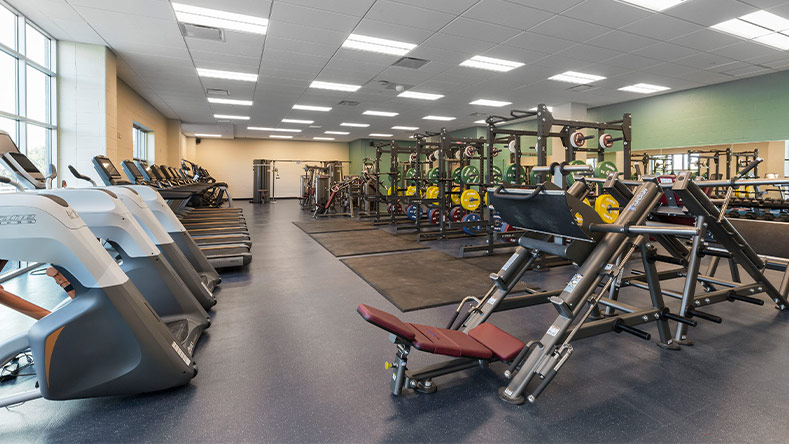
Using the building’s already-existing NBA-grade basketball courts as the facilities focal point, DMR converted the rest of the building, previously used for offices, into spaces traditionally expected at a YMCA including an expansive fitness center with Technogym cardio machines, an aquatic with a six-lane, Olympic-sized competition pool, and daycare at the Mara Center for Early Childhood Learning, with modern add-ons like informal meeting spaces throughout the building, group exercise classes, and education space for students and adults of all ages, mental and fitness levels.

The Meadowlands Area YMCA is the first centralized location for the organization’s 15,000 members from eight municipalities in almost a century.  It opened in 2017.

Indoor Athletic Facility

DMR’s plans will convert a currently vacant 2.5-acre lot on Meadowlands Parkway in Secaucus into a 51,750 square foot indoor sports facility for the Town of Secaucus to fill the recreation department’s gap in adequate centralized space for group youth and adult sports activities, training and league competitions in sports including football, soccer, wrestling and lacrosse.

In addition to a 24,300-square foot synthetic turf field that can be divided into up to four fields, the new facility will include administration offices, lockers, a convenience stand, storage, and bleachers with a forced air heating system.

Construction on the project will start in summer 2019 and is expected to be completed in summer 2020.

Educational Athletic Facility

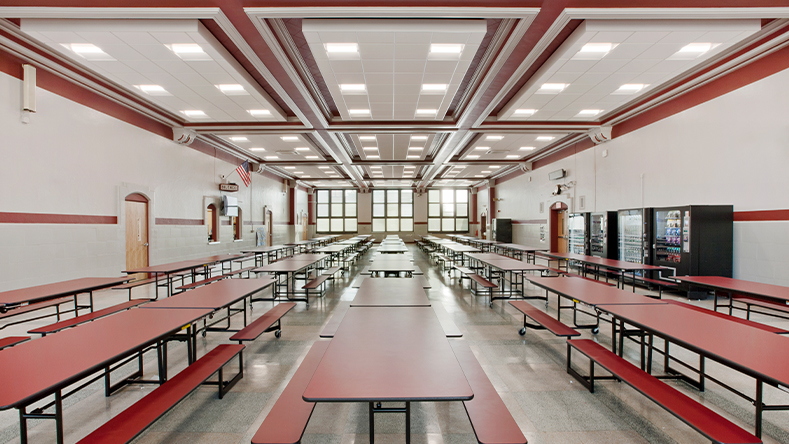
Students at the newly-opened Frank J. Gargiulo Campus in Secaucus are taking physical education and elective classes that rival options more likely found at a spa or private club with its 12,000-square foot gymnasium complemented by indoor spaces for yoga, dance, cross fit training, cycling, Martial arts, weight training, and climbing.  The school’s campus includes a paved outdoor path for walking and running with fitness stations throughout the path.

The design team included numerous professionals who paid special care to keep the fitness areas separate from each other and the rest of the school, employing a sound engineer to ensure that sound and vibrations from one area of the school do not affect the utilization of other areas.

Space was also dedicated to faculty to encourage their use of the exercise options with locker rooms separate from those used by students, complete with showers and saunas.

Green building isn’t far flung anymore, and a NJ firm is celebrating that fact

Green building isn’t far flung anymore, and a NJ firm is celebrating that fact 960 540 DMR Architects

Written by Christine Fisher. Produced by Brandon Bagley.

There’s a Nelson Mandela quote that reads, “There is nothing like returning to a place that remains unchanged to find the ways in which you yourself have altered.” In a way, Lloyd Rosenberg, founder of DMR Architects, has done just that.

When Rosenberg founded DMR Architects in 1991, the first buildings he designed were schools. He had been designing them since graduating from architecture school, and he’d amassed potential clients who agreed to give his new company a try.

Twenty-five years later, Rosenberg is still building schools, returning in a sense to his roots, but lots of other things have changed. For starters, DMR Architects has diversified, and it’s become a leader in green building.

Hudson County’s $144 million high school

In 2016, DMR Architects celebrated its 25th anniversary, a milestone Rosenberg is especially proud of. The company has a staff of 40, and is currently building a $144-million high school for Hudson County, New Jersey.

“The high school we’re doing now is spectacular. It’s going to be a building that’s going to set the bar for high schools throughout the country.”

DMR Architects is the lead designer on that 350,000-square-foot design-build project, for which it’s seeking LEED Platinum Certification.

“The high school we’re doing now is spectacular,” Rosenberg says. “It’s going to be a building that’s going to set the bar for high schools throughout the country—the technology and programs and infrastructure and energy savings, all the things you’d want to put in a school.”

The building will have solar power, geothermal heating and cooling, a partial underground garage for employees and water retention systems. A roof will capture storm water to irrigate landscaping, and all of the mechanical systems are being built with the best green building products on the market.

The building was designed to suit what educators hope to teach, and it will have a fabrication lab, applied science labs, a television production and radio broadcasting studio, digital media labs, a culinary lab, architecture and engineering labs, a hydroponics lab, musical theater, a dance and drama studio, yoga, judo and other fitness rooms.

Rosenberg has always designed schools, but now the green technologies, and the administrators’ willingness to embrace them, have changed.

An easier pitch

Rosenberg has designed thousands of schools and public and private buildings in New Jersey, and says he was “very much in the forefront” of sustainable design.

In the beginning, he had to make presentations explaining why green buildings cost more than traditional buildings. In the early ’90s, when DMR Architects started, green buildings often cost 10 to 30 percent more.

“I don’t have to make that pitch anymore,” Rosenberg says.

Today, he says, the difference between an energy-efficient building and a non energy-efficient building is almost negligible. That’s partly because all of the required products are readily available.

“The cost is in the certification, the paperwork, the testing, going back and doing some examinations and reports to prove that it’s been done [right], but the basic building doesn’t cost any more, it may even cost less,” Rosenberg says.

The motivation has changed, too. DMR Architects’ first green building clients sought LEED Certification as a marketing tool. Clients today opt for green buildings to save money through energy efficiency and utility savings.

The benefits of diversifying

DMR Architects has taken on medical buildings, public and private buildings, institutions, even a train station.

“I’d always hoped to be a midsized architectural firm that was diversified in what we do,” Rosenberg says.

He sought variety so that staff wouldn’t feel pigeonholed in one sector and to help protect the company during economic downturns. At times, the residential market has boomed for a few years and then gone flat. At other times, it’s been the public sector.

Outside of providing resiliency, trying out different sector projects has given perspective. Clients benefit from that different view, Rosenberg says.

“We built a train station, not necessarily in our sweet spot, but we were actually complimented because we took a fresh approach, not one that someone had done over and over and over again,” Rosenberg says. “We actually proposed to the user a different way of doing something, which they embraced, and now it’s the standard for them.”

Shared success

The firm makes a point of hiring “top talent from the top” and “top talent from the bottom,” which gives it the experience of senior staff and the technological expertise of recent graduates. While the new hires helped more experienced employees stay relevant, the senior people help new hires “learn what they don’t know.”

“I love young people that come in with enthusiasm,” Rosenberg says. “They want to learn and the more you throw at them the better job they do. I love to see people who came here as a graduate and now they’re project managers. I’m proud of those people that I’ve given the opportunity to do it. I’ve helped them, but they’ve really done it on their own.”

When DMR Architects turned 25, the firm hosted a series of employee-engagement activities—like a company boat ride and company picnic—to celebrate not just the success of the firm, but the success of its individual employees.

“When we started in 1991, we had three people; we now have 40,” Rosenberg says. “People that are here have been with me some 24 years. Most of the staff has over 15 years with the firm… so I think it’s successful when you have the vast majority of the staff that has been here that long.”

This article was originally featured on US Builders Review.

Former Annin Flag Factory Is new Standard for Luxury Apartment Living

Former Annin Flag Factory Is new Standard for Luxury Apartment Living 789 444 DMR Architects

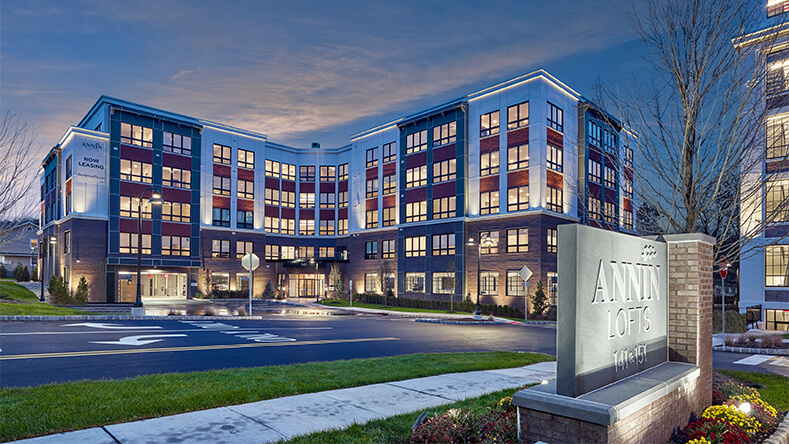
The rehabilitation of the former Annin Flag Factory and completion of a new sister building at 151 Bloomfield Avenue into Annin Lofts marks a new standard for luxury rental options in Essex County.

Joint venture partners Russo Development and Dinallo Construction Corporation used the original building’s industrial history and façade as inspiration incorporating exposed brick, beams and duct work, shiplap accents, industrial lighting, high ceilings and floor-to-ceiling windows into the design of its 52 loft-style apartment homes and common areas.

The 60 apartment homes in the second building complements the first with large windows and expansive floorplans but with finished walls and ceilings for those going for a more traditional vibe.

“Annin Lofts is the only residential rental option in the area that offers homes in a rehabbed historic building and a brand-new build in the same place,” Edward Russo, CEO of Russo Development, said.  “Our design team seamlessly married the vintage industrial vibe with modern conveniences to meet the market’s desire for diverse and unique living spaces.”

“Converting a 100-year old industrial building into modern, diverse living spaces always presents unique challenges,” Donald N. Dinallo, President and CEO of Dinallo Construction Corporation, who built the project, said. “Each apartment home has something special—a private outdoor space, original materials, or an imaginative floorplan—providing a distinctive canvas for residents to make their own once they move in.”

DMR designed the project, which includes a sixth floor penthouse structure to the Annin building to accommodate a large indoor club room and two outdoor entertaining spaces that residents of both buildings can use. The design also included four penthouse homes with wrap-around porches and 180-degree views of the surrounding valley.

The name of the project was chosen to respect the legacy of Annin, the largest and oldest flagmaker in the United States. The Annin Flag Company occupied the property from 1919 to 2013 where it made numerous flags of historical significance including those flown atop Mt. Suribachi during World War II, on the moon during the Apollo 11 mission, and during America’s bicentennial celebration in 1976.

The $150M Frank J. Gargiulo Campus Opens

The $150M Frank J. Gargiulo Campus Opens 789 444 DMR Architects

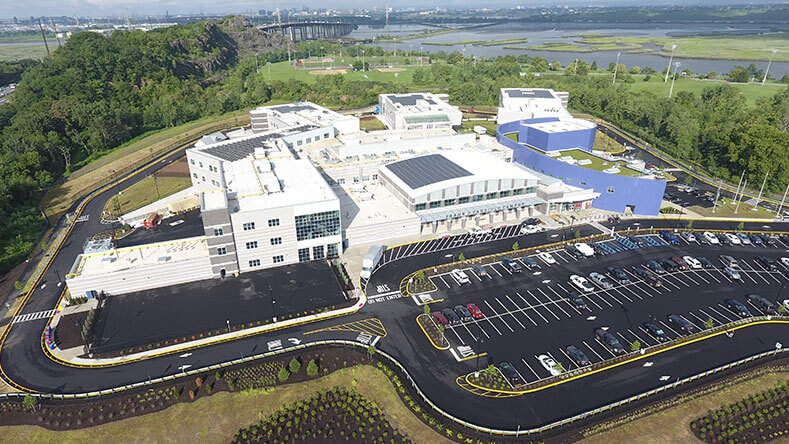
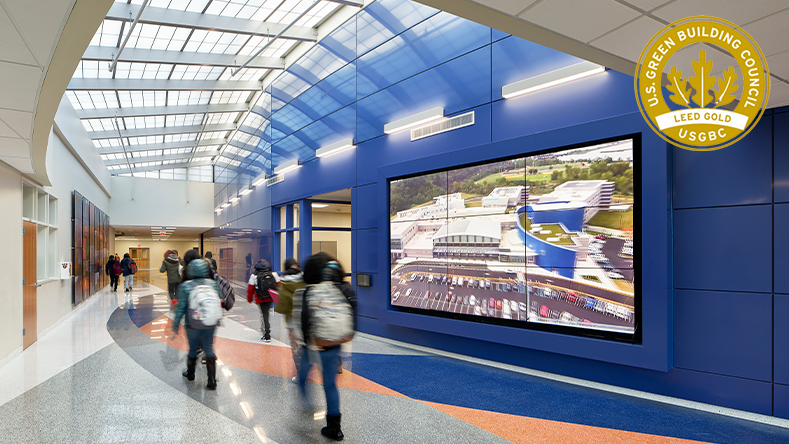
The Frank J. Gargiulo Campus, described as the “gem of high schools in Hudson County,” is open.

Following an aggressive design and construction schedule of less than 2 1/2 years, last week marked the first full week of school on the 20-acre campus in Secaucus, home to High Tech High School, KAS Prep and Hudson Technical.

The new, $150 million facility educates nearly 2,000 students in more than 70 leading-edge classrooms and specialty spaces. The Hudson County Improvement Authority (HCIA) managed the design and construction process for Hudson County Schools of Technology (HCST) through a team of numerous professionals, which along with DMR Architects, included RSC Architects as bridging architect, MAST Construction Services as owner’s representative and construction manager and Terminal Construction Corporation as general contractor.

The 350,000-square-foot county vocational magnet school combines technically-focused, hands-on learning with a challenging academic curriculum.

“The Frank J. Gargiulo Campus will quickly become the gold standard for technical high schools across the country. Our design team, working collaboratively with our educators, have created something truly revolutionary. I know that it will serve our students and staff with the resources to drive learning to the next level,” says Amy Lin-Rodriguez, acting superintendent of HCST.

Among many advanced features, the new campus includes a fabrication lab, a black box theater, a performing arts auditorium, 80-inch interactive monitors in classrooms, and a TV production studio with a functioning control room. Outdoor features include a hydroponic rooftop garden where students will grow food to be used in the culinary kitchen lab.

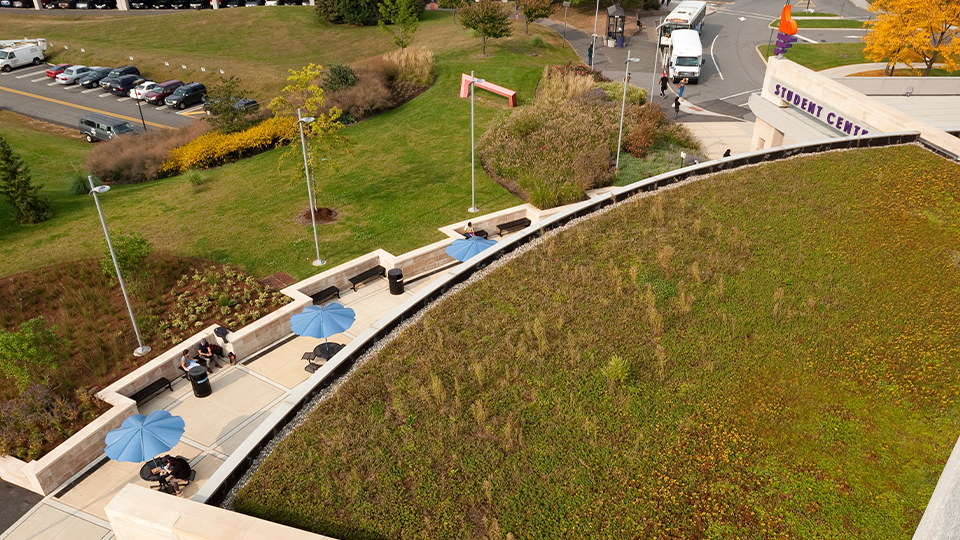
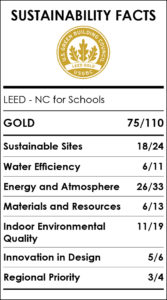
This school was designed to meet the Leadership in Energy and Environmental Design’s (LEED) rigorous gold standards and requirements for sustainability. Features like water efficient landscaping, geothermal heating, green roof and wind turbines were implemented to reduce the amount of greenhouse gases and wastewater emitted from the campus.

The new campus was dedicated to the former superintendent of HCST, Frank J. Gargiulo, during a ceremony on September 7.

“I am humbled by the decision to dedicate this campus in my name,” says Frank J. Gargiulo, former superintendent of HCST. “These students are among the brightest in the country and deserve a quality space to study and prepare themselves academically for the future.”

East Brunswick Route 18 Redevelopment Moves Forward

East Brunswick Route 18 Redevelopment Moves Forward 789 444 DMR Architects

The redevelopment of one of New Jersey’s busiest commercial corridors, Route 18 in East Brunswick, is underway, with the latest step forward coming in the form of two RFPs to developers.

Last summer, the East Brunswick Redevelopment Agency retained DMR to develop several redevelopment plans on numerous tracts of land within the Township.

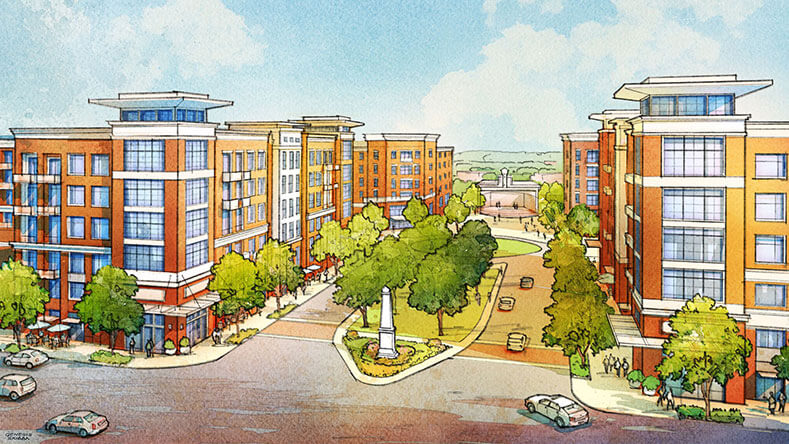
On one of those tracts, 88 acres that includes the Route 18 shopping center and Loehmanns Plaza, DMR developed a redevelopment plan that will bring these lots, all currently under performing or vacant, to life. Despite traffic of more 100,000 cars daily, Route 18 has one of the highest vacancy rates in the State, a challenge that the Township needed to address among other issues including a lack of a downtown center, a growing suburban population and a high volume of commuters who travel to the Township on their way to New York City.

As part of this effort, DMR developed multiple concept plans which called for a town center, including 95,000 SF of retail, 700 units of residential, 62,000 SF of office space, and a parking structure. The plan also includes a hotel, a boulevard and open space.

The RFPs to developers, released last week, are an important step toward implementing needed change.

“We are so excited to welcome a developer to our dedicated team of professionals who are pushing forward our 2020 Vision,” Mayor Brad Cohen said, “Located at the center of the State and close to Rutgers, every major highway and the shore, we are hopeful this project will attract significant interest from the development community.

Hunterdon Healthcare Opens Ambulatory Surgery Center

Hunterdon Healthcare Opens Ambulatory Surgery Center 789 444 DMR Architects

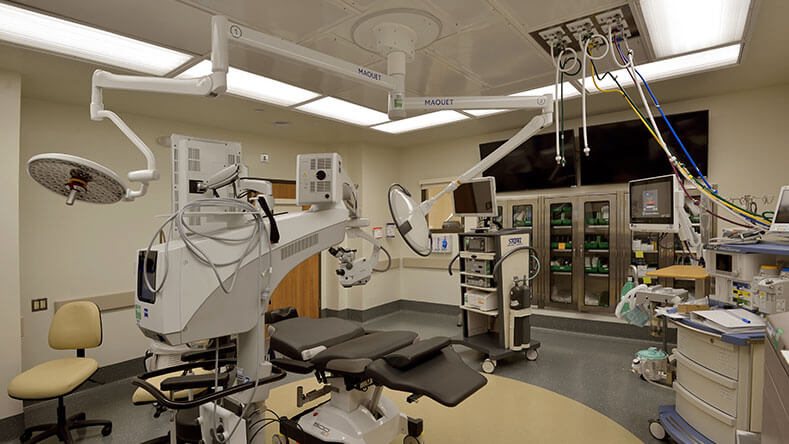
On June 14 DMR joined Hunterdon Healthcare for the ribbon cutting of the new Ambulatory Surgery Center at the healthcare system’s Bridgewater facility, the second phase of a project that transformed a former Bank of America building into medical office space.

“While healthcare system expansion is now becoming the norm, Hunterdon Healthcare was ahead of the curve, recognizing and responding to changing residential patterns years ago,” Lloyd A.  Rosenberg, AIA. “New Jersey residents are moving farther out from urban and suburban areas where a high quality of life is more affordable, and businesses of all kinds are smart to expand or move close to potential customers, or in this case, patients.”

“Patients shop around for healthcare the same way they do for other products and services,” he added. “We’re reimagining spaces to support Hunterdon Healthcare’s goal to provide personalized care in easily accessible office spaces.”

This project is DMR’s latest in a thriving portfolio for the rapidly-expanding Hunterdon Healthcare system, a portfolio which also includes the imaging center, a third phase, at the Bridgewater facility; two phases that brought pediatrics, podiatry, behavioral health and other specialties to the system’s facility in Hawk Pointe; and a family practice to the system’s Hickory Run Medical Office Building in Califon. DMR also previously completed the Maternity and Newborn Care Unit at the Flemington facility.

How DMR Architects took ‘design’ into multiple business areas

How DMR Architects took ‘design’ into multiple business areas 2000 1125 DMR Architects

In our continuing series of interviews with members of the Rutgers Center for Real Estate’s Advisory Board and Emerging Leaders Council, Kevin Riordan (KR) of the Center sat down with Lloyd Rosenberg AIA (LR), President & CEO of DMR Architects to get his insights and perspectives on the firm and its business model.

KR: Lloyd, while your company’s name includes the word ‘Architect’, your firm is actually involved in a number of various design and planning initiatives. Please give our readers an overview of how your firm evolved and the different segments of the real estate business you currently serve.

LR: Given my background as an architect, the firm started out in 1991 with that as its primary focus. However, an interesting confluence of events began to occur which caused our company to expand beyond our basic discipline of architecture. First, we recognized that our clients were not singularly focused on delivering solely built environments, but rather, we saw there were opportunities to work with our clients to build, expand and plan entire communities and environments. We were able to build on this and expand into planning. We expanded into sustainable design in a similar way. Members of our staff were some of the earliest to embrace sustainable design, which led us to designing the first LEED Silver public school in New Jersey. While I am proud that we have been able to watch trends and expand our capabilities in that way, adding talented staff has been a large part of our growth as well. I think we offer a very uniquely qualified and diversely talented staff, and that has helped us take on a very diverse set of projects.

KR: So what project comes to mind where you combined these multiple disciplines to present a turnkey solution for a client?

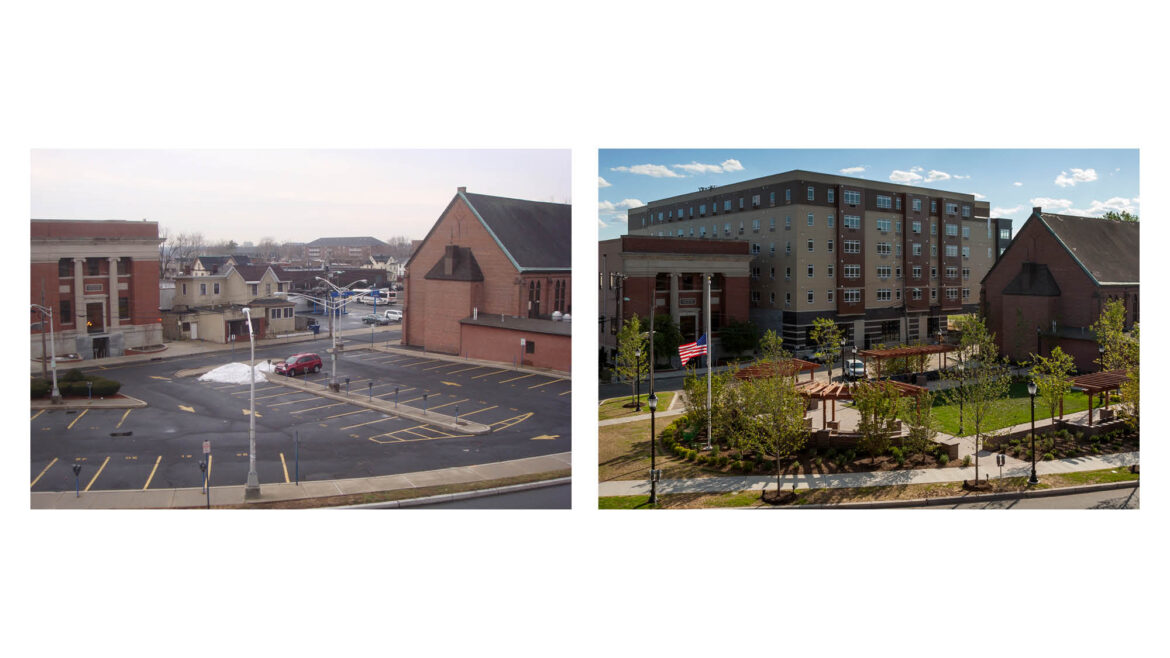
LR: The best example I can think of would be in the City of Hackensack, where we have supported the City from both a professional planning and architectural design perspective. The planning work and its successes have been significant in downtown Hackensack, and some of these projects have required architectural support as well. Just last month, the City cut the ribbon on the new Hackensack Cultural and Performing Arts Center. This was the final phase of a four-phase project that brought a public park and cultural arts center to the downtown. In addition to serving as the redevelopment planner, DMR designed the park and the Cultural and Performing Arts Centers.

KR: 1991 was a bad time for real estate. So tell us your thought process on starting a company in an environment where not only credit but RFP’s from building owners and developers were not piled high on your desk.

LR: Well let’s start by clarifying that 1991 was not just a bad time for real estate, the sector was in a depression. So my thought was ‘it can’t get any worse from here’ and we started the company. Something is always happening in real estate. At the time it was tenant retention; less value creation. And since we were a much smaller organization at the time, we could afford to take on some projects at breakeven levels of profitability just to establish our name. There was also a change in ownership of properties due to foreclosures, which opened up a new group of potential clients. Looking back, I don’t think we were calling a bottom to the cycle but we were pretty close to it. And to add to the previous question, the addition of the different services has allowed us to diversify our revenue over the cycles.

KR: Is it simply a diversification model that has led to DMR’s success or can you point to other factors?

LR: Experience is certainly a good factor to have continued success. But the additional capabilities of the firm have helped brand us that we can provide turnkey solutions for clients. But what I see as a source to grow our brand has been our willingness to embrace challenges that were not necessarily within our bandwidth. For example, we designed the train station for the spur link to the sports complex in the Meadowlands. Since we never did something like that before, I think it energized the staff. And that engagement has now enabled us to be the designer of the train station in Bloomfield, New Jersey.

KR: Staying with trains for a moment, what are you trying to achieve with your station design in Bloomfield?

LR: If you know this station, you know that the platforms are about 20 feet above grade. So the first issue that must be addressed is accessibility. And while people need and want accessibility, they will also want it to be convenient. The Township of Bloomfield, which owns this station, wants an aesthetic to the site. So given the significant development around the station, we have to incorporate both current structures as well as future projects. Those requirements serve DMR well since we are designing both the existing building as the environment it is in. Finally, the station has to be comfortable. This will probably not be limited to just padded benches. Again, while this type of project may have challenging aspects, it is also the type the team gets excited about.

KR: You have been in business 26 years. You started out as three employees and now have more than 40. You have expanded your lines of business as you have seen an increase in the scope of services required. So what are the challenges to your business? What is rewarding?

LR: First and foremost is retaining employees. When you are a service provider, staff longevity and experience provide prospective clients the confidence to check that box. As clients have sought solutions for projects that are both the built structure as well as its surrounding environment, it has become very important to manage the expectations of your client. As you add complexity or even more entities to work on a project, unforeseen results can occur. This is particularly acute as the clients are more informed also. Since we have become more involved in community planning, it is rewarding to see the energy and enthusiasm the staff expends on these assignments. It may be a result that someone either lives in that community or near it or knows a person who lives in it and a connection is created. Other times it is simply seeing the completion of a project knowing that one + one equals three.

KR: Lloyd, great spending time with you and providing some insight to the design and planning business.

This article originally appeared in Rutgers Center for Real Estate – Blog.

Bergen architectural firm seizes big opportunities, thrives on a challenge

Bergen architectural firm seizes big opportunities, thrives on a challenge 150 150 DMR Architects

by Linda Moss

Architect Lloyd Rosenberg was undaunted when plans for a nearly $1 billion commercial development in Ridgefield Park had to be dramatically reconfigured to accommodate Al and Alice, a pair of bald eagles.

“We had to redesign the whole project,” said Rosenberg, president and chief executive officer of DMR Architects in Hasbrouck Heights. “It’s just part of what we have to do … It’s not unusual.”

DMR has done extensive work in North Jersey, where the only land left to develop often poses environmental or wildlife-conservation challenges, be it protecting eagles or bog turtles, according to Rosenberg. If you live in the region, odds are pretty good that you’ve set eyes on at least one place or project DMR has worked on, be it a hospital like Holy Name Medical Center in Teaneck, the Meadowlands rail station, downtown Hackensack’s redevelopment or the New Jersey Vietnam Veterans’ Memorial in Holmdel.

This year, booming DMR, the fourth-largest architectural firm in the state in terms of staff size, is busy with two big projects. It is architect and planner for SkyMark, a Ridgefield Park development — in the works for two decades — that will include about 1,500 residential units, 350,000 square feet of retail space and a 300-room hotel when its final phase is complete. Construction on the project, dubbed “Eagle’s Nest” by some, is finally expected to begin this spring. And work is continuing on Hudson County’s new $144 million High Tech High School in Secaucus, designed by DMR. The final steel beam was installed last week at the site, 22 acres adjacent to Laurel Hill County Park. The 350,000-square-foot facility is slated to open in September next year.

A third DMR project, the $10 million transformation of the former Nets basketball team’s training center in East Rutherford to the home of the Meadowlands Area YMCA, opens in April.

Buoyed by such undertakings, and the economy’s recovery, DMR enjoyed a banner year in 2016, when it celebrated its 25th anniversary. The firm, which has about 100 projects in various stages, saw its projected revenue last year climb about 84 percent to $9.8 million from $5.3 million in 2015. So it could accommodate its increased workload, last year DMR added nine employees, bringing its staff roster to 39. And last week, for the first time, DMR named five partners, Rosenberg said, to spread management duties and to lay a foundation for his succession.

New high school was a boon

DMR founder Rosenberg, who turned 74 last week, said the firm got a big boost last year because work on the regional high school in Hudson County got off the ground, a project being bankrolled by the county and the state. He acknowledged that DMR suffered some bad years, most notably during the Great Recession, and cited the cyclical nature of his business in explaining why 2016 was stellar.

“The real estate market was strong in New Jersey,” Rosenberg said. “The municipalities we work with felt confident to go out and have their facilities improved. The private developers – low-interest rate, greater demand, increased values – they became strong. The reason we’re so successful is we have a very diverse practice. So we do private work. We do schools and colleges. We do public facilities, police stations and municipal buildings. We do office buildings. We do healthcare … We have a diverse practice, and all of the sectors in the market sort of increased volume.”

That’s the strategy behind having a full-service architectural practice, according to Rosenberg.

“We anticipate at times one sector is going to go down, and one sector is going to go up,” he said. “This particular year [2016] everybody went up.

Consequently, we did better and we hired more people.”

DMR’s recent growth appears to have been outpacing its peers. The American Institute of Architects tracks billings nationally and regionally through its Architecture Billings Index, or ABI , said Ben Lee, the new president of the group’s New Jersey chapter and chief financial officer for NK Architects in Morristown. In November, the index was 50.6 nationally and 50.8 for the Northeast, according to Lee. Anything above 50 represents an increase in billings. Referring to the Northeast’s performance, he said, “It’s good, but it’s not moving a full digit.”

Eagle issue resolved at SkyMark

The SkyMark center rivals American Dream Meadowlands, the massive retail-entertainment complex being built in the East Rutherford Meadowlands, in terms of its delays.

“We’ve owned this property since 1999,” said Tony Noce, development manager for Paramus-based SkyMark Development Co. “It was originally going to be developed as office but now it’s mixed use and it’s just a complex project … We’ve done all the environmental remediation. There was an eagle’s nest. We had to get major infrastructure improvements approved with the N.J. DOT [Department of Transportation] and the Turnpike Authority to provide access to the site. All these things take a lot of time to get.”

As the architect and planner, Rosenberg said DMR had the task of reworking SkyMark’s plans to create a five-acre buffer to protect the two eagles and their nest.

Ultimately, the plan approved by federal officials will carve out an 11-acre eagle preserve on the southern end of the SkyMark property, taking up about 20 percent of the 55-acre site, Noce said. SkyMark will be built at the crossroads of the New Jersey Turnpike and routes 46 and 80.

Noce said he and developer Ralph Ianuzzi Jr. are in the final stages of putting together SkyMark’s financing. They are slated to meet with the Ridgefield Park village board of commissioners this week to update them on the project, according to Mayor George Fosdick. Noce said he expects construction to start in late spring.

Police headquarters projects 

This year construction on another one of DMR’s projects, a $7 million Garfield police station, is also slated to begin. The current headquarters on Midland Avenue, constructed in 1960,  is “woefully undersized” for the 66-member police force and “was built for another era,” City Manager Thomas Duch said. Local police headquarters have become another DMR area of expertise, according to Rosenberg.

Originally, plans were for another architecture firm to design the new Garfield police headquarters. However, city officials gave DMR the job after they were “impressed” by a presentation by Rosenberg, as well as by his design work at the Bergen County Public Safety Operations Center in Mahwah, according to Duch.

“Many of these police stations now are outdated,” Rosenberg said. “They don’t have the current technology. Their facilities are not safe. They’re not habitable.”

Rosenberg said it’s hard to make forecasts for this year, but that he thinks President Trump will be effective helping the business community and stimulating the economy, especially in the tri-state region.

“I hope that he does the things that he said he’s going to do with infrastructure and public work and hospitals and schools,” Rosenberg said. “We do live in his geographic area.”

This article originally appeared on NorthJersey.com.

DMR Architects CEO sees opportunity to grow his firm in China

DMR Architects CEO sees opportunity to grow his firm in China 960 540 DMR Architects

by Joshua Burd

In mid-November, Lloyd Rosenberg was a long way from his home state of New Jersey.

But perhaps it takes that kind of journey to see what he saw during his 10-day trip in China, one that included tours of several breathtaking, historic villages in the southwestern region of the country.

“They were absolutely magnificent,” said Rosenberg, CEO and president of DMR Architects, in Hasbrouck Heights. “They were built on hillsides, built on rivers—it was spectacular.”

For Rosenberg, they are among the lasting images from a trip that could help grow his firm’s presence in China. DMR has since partnered with a Beijing-based architecture firm, Long On Group, in submitting designs for a rail-served 24-acre site in Lishui City that the local government hopes to redevelop.

The proposals, which are due this week, aim to transform the area around a high-speed railway station into a tourism destination that will include hotels, retail, restaurants, entertainment and public ground transportation.

“They’re very aggressive in planning, very aggressive in development, very aggressive in entertainment,” he said. “I would say the biggest thing I saw was the amount of tourism that they’re promoting—internal to China—people in China traveling around to see other parts of their country and be tourists.

“It’s not dissimilar to us.”

But as Rosenberg’s firm gets involved in redevelopment overseas, his trip also allowed him to weigh in on how to preserve China’s history.

This involvement stems largely from Rosenberg’s longtime friendship with James Jao, a fellow architect who once practiced in New York City before moving to Beijing more than 25 years ago. DMR has done consulting work for Jao’s firm, Long On Group, prompting Rosenberg and his staff to visit China several times in recent years.

His most recent visit took place in November, when he was invited to speak at the Qindongnan Conference on Preserving the Traditional Chinese Village. Appearing before some 500 senior government and planning officials, Rosenberg said one of his main objectives was to explain the process of preserving historic buildings and sites in the U.S., with the idea China could adopt such an approach for its own small villages that are exponentially older than anything in his home country.

“We have a method in place that exists that seems to work,” said Rosenberg, who was “honored to be able to speak as a representative of the architectural community” in the U.S. “And if they want to model something, it’s a model that could be replicated.”

He noted that the U.S. approach is often tied to tourism and entertainment, which presents one avenue for preserving China’s older villages as residents leave to pursue education and jobs in more urban areas.

For Rosenberg, the trip was bookended by private tours of villages in southwestern China, including Guiyang, Kaili City, Qiandongnan and Lishui, he said. The journey offered him a different perspective from his previous visits, which were tied to DMR’s master planning work for a 420-acre community in Shanghai’s Xin Jiang Wan township.

That plan included residential housing for 16,000 residents, a pedestrian retail strip, community and recreational facility, school building and office park, Rosenberg said. The project features include streams, rivers, lakes and landscape that connects one back to nature, which he said is at the heart of the Chinese culture.

It’s an example of the importance of towing the line between redevelopment and preservation in China, a dynamic that DMR Architects now has in mind as it seeks to do work in Lishui City and elsewhere.

“The Chinese people have a history that they’re proud of and they want to maintain that,” Rosenberg said. “They’re very proud of their history, they’re proud of their nationality and their culture and they want to visit the new and the old in China, so they want to visit new places that are being developed and they want to visit the old places that go back to their ancestors.”

This article originally appeared on NJBiz.