
News

Beyond Design: DMR’s Pradeep Kapoor Speaks on the Business Side of Architecture

Beyond Design: DMR’s Pradeep Kapoor Speaks on the Business Side of Architecture 789 444 DMR Architects

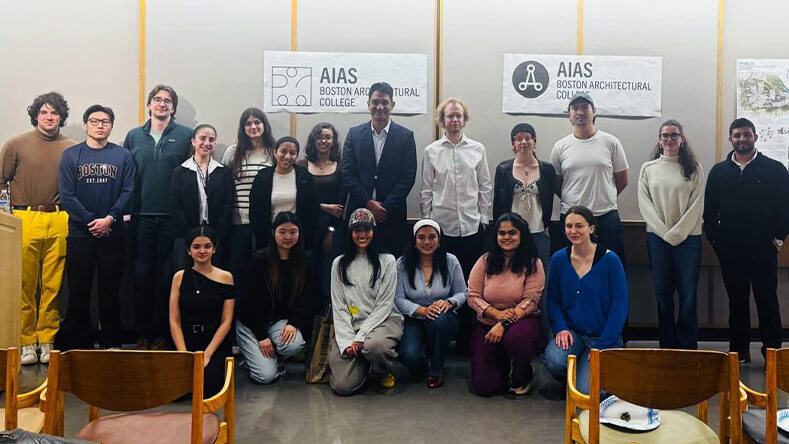
Architecture students are trained to design. Far fewer are taught how to run a project, build a client relationship, or sustain a business. Those were the gaps Pradeep Kapoor addressed in his lecture, “Business in Design,” a two-hour, discussion-based session delivered on April 17 at Boston Architectural College.

Organized by the college’s chapter of the American Institute of Architecture Students, the session also included a student exhibition, “Feedback Loop,” featuring project pin-ups and discussion.

Drawing from his own career progression, from designer in 2001 to CEO in 2024, Kapoor outlined what he wished he had understood earlier and how the role of an architect evolves over time. Early in his career, the focus was on honing design skills. As his responsibilities grew, the role expanded to include understanding project scope and fees, managing budgets and schedules, and navigating client expectations. At the leadership level, the emphasis shifted to building trust, winning repeat work, and driving the business forward.

The lecture focused on what is often not taught in architecture school: how projects are funded, that clients are buying a project rather than just a design, and why a well-designed project can still be a poor business decision. Kapoor emphasized the importance of clearly explaining budget, schedule and risk, and the role architects play in keeping projects viable so they can ultimately be built.

Additional topics included fee writing, negotiation, business writing, marketing and business development, and how firms pursue work through RFPs and RFQs. Kapoor also addressed how architects evaluate project profitability, from steady, reliable work to projects that may offer visibility but limited financial return.

“Design is essential, but it is only one part of the process,” Kapoor said. “The ability to manage the business side is what allows projects to move forward and ultimately get built.”

A central theme was that creativity is not enough unless a project can be financed, approved, and delivered and that understanding funding sources, public processes and client priorities is critical to keeping projects viable.

“Business is how a design enterprise executes, not merely on a single project, but in building an enduring organization that is mission-driven and sustainable over decades and beyond,” said Dr. Mahesh Daas, DPACSA, President, Boston Architectural College. “The real magic of building, running, and aligning design organizations lies in the design of the business itself. That is why this conversation matters so much for our students. I’m so grateful that Pradeep Kapoor is kindly sharing his inspiring leadership experience to guide the next generation.”

The session included case studies and examples from DMR’s portfolio, along with an interactive discussion of student work, offering a practical look at how design and business intersect in the real world.
East Brunswick Opens New Multi-Purpose Ice Arena, Creating a Year-Round Community Destination

East Brunswick Opens New Multi-Purpose Ice Arena, Creating a Year-Round Community Destination 789 444 DMR Architects

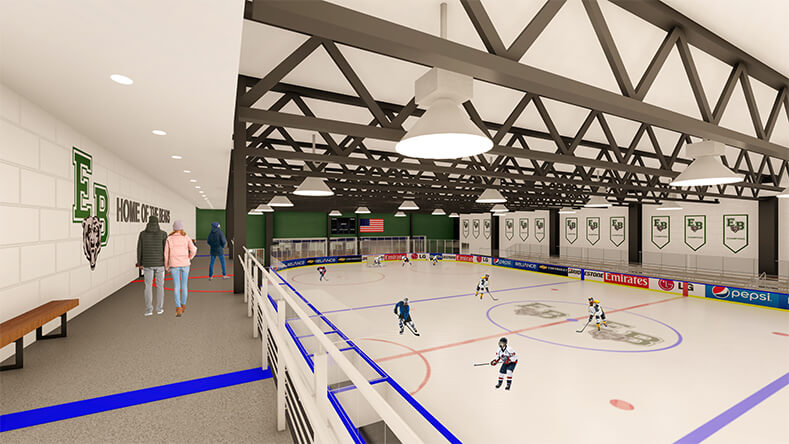
East Brunswick officially opened its new multi-purpose ice arena on February 2, delivering a modern recreational facility that will serve as a year-round community hub.

The rink was designed to support recreational skating and youth hockey while also accommodating public events, private parties and fundraisers. By expanding beyond traditional ice programming, the facility is expected to become a central gathering place for residents and a destination for families and teams from across the region. In addition to promoting active lifestyles, the rink creates new revenue opportunities for the township.

The project reflects a growing understanding among municipalities that recreational infrastructure has long-term value. Facilities like ice rinks and athletic centers are increasingly viewed as essential civic spaces that bring people together and strengthen community identity.

The 84,000 SF, twin-rink arena is equipped with a rental area, multi-purpose room, party room, concession stand and locker rooms. Both rinks include bleacher seating and a second-floor balcony marked with details on the floor designating center ice, goalie creases and the blue lines. At rink one, a raised viewing platform adjacent to the lobby and concessions area, provides a third viewing experience through large glass windows. The symbolic lobby is marked by a Kalwall-enclosure intended to represent an ice cube.

DMR Awarded Two New Design-Build School Projects Following Two Successful Openings

DMR Awarded Two New Design-Build School Projects Following Two Successful Openings 789 444 DMR Architects

DMR has been awarded two new school design-build projects in West New York and Elizabeth, marking another major milestone in the firm’s expanding design-build portfolio.  DMR was selected in partnership with the Terminal Construction Corporation for both of these projects and is working under the oversight of the New Jersey Schools Development Authority (NJSDA), which manages the program. The news comes after the successful September openings of DMR’s most recent design-build projects in Wood-Ridge and Bayonne.

The new Elizabeth school is a $76.8 million investment and will serve more than 900 students throughout 142,000 SF and is one of the largest of its kind in the city. The new facility will include seven pre-kindergarten classrooms; six kindergarten classrooms; six self-contained special education classrooms; 22 general classrooms for grades 1-5; nine general classrooms for grades 6-8; one resource room; five small group instruction rooms; three science classrooms; and dedicated space for vocal music, art and a media center with a makerspace. The project is expected to be completed in 2028.

The new West New York project is 162,000 SF middle school for grades 6–8, representing a $92 million investment that will serve approximately 875 students. The new facility will include 30 general classrooms, six science labs, multiple science prep rooms, dedicated art rooms, and a wide range of specialized learning and student-support spaces designed to offer a modern, flexible, and technology-forward educational environment.  The project is expected to be completed in 2028.

This project follows two successful design-build school completions by DMR, both of which opened in September 2025.

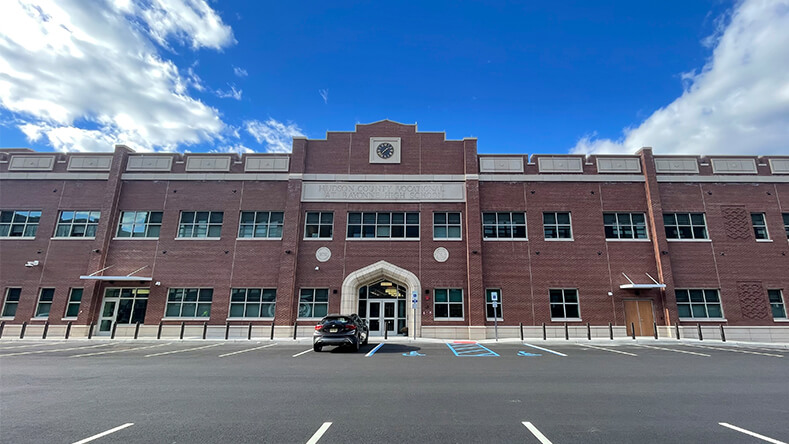
  • The Hudson County Schools of Technology Craig Guy Center at Bayonne High School, a 20,000 SF, $24 million vocational center with culinary labs and fabrication shops tailored for career and technical education.
  • Highland Avenue Learning Annex & Recreation Center in Wood-Ridge, a 56,500 SF addition and 44,000 SF renovation to the existing Doyle School that addressed enrollment growth with new classrooms, flexible learning spaces, and support facilities.

Together, these four projects reflect how the design-build model is being used to reduce delays, improve cost certainty, and unify design and construction under a single contract.

“Design-build allows us to accelerate the entire process in ways traditional delivery can’t,” said Pradeep Kapoor, AIA. “With tight timelines, we’re often able to begin critical-path construction months earlier because design and construction happen in parallel. That level of coordination and responsiveness is key when you’re building schools for growing communities.”

“Our priority was to deliver a high-quality facility on a timeline that aligned with our community’s needs,” said Mayor Paul Sarlo of Wood-Ridge. “The design-build approach allowed us to move faster and stay coordinated throughout the process, which was essential for a project of this scale. The new Highland Avenue Learning Annex and Recreation Center has already had a positive impact on our district.”

“The design-build process is efficient because everyone is working toward the same goal from the start,” said Donald N. Dinallo, President & CEO of Terminal Construction Corporation. “When you are side by side with an architect like DMR, the workflow becomes even smoother. Decisions are faster, challenges are resolved quickly, and the whole project benefits.”

Design-build was made more accessible to public agencies in New Jersey following the Design-Build Construction Services Procurement Act of 2021, which allows municipalities and other government bodies to pursue this model for projects over $5 million. The legislation has helped create more flexibility to help meet tight timelines and evolving student needs.

How Smarter Library Spaces Are Shaping Smarter Communities

How Smarter Library Spaces Are Shaping Smarter Communities 789 444 DMR Architects

Libraries don’t just hold knowledge—they help build it. Across New Jersey, DMR is leading a wave of library redesigns that are making communities smarter, more connected, and better prepared for the future. From the Dr. Martin Luther King Jr. Library & Learning Center at Essex County College in Newark to the newly transformed Middletown Township Public Library, DMR’s work is redefining what a library can be: a place where history, technology, and community intersect to inspire lifelong learning and growth.

Redesigned libraries do more than update infrastructure. According to national data, renovated libraries see attendance increases of 30–80%, program participation more than double, and measurable gains in student literacy and digital access. “These aren’t just renovations—they’re reinventions shaped by a deep understanding of how these communities use public space,” said Kurt Vierheilig, AIA, LEED AP BD+C. “A modern library is a civic engine, a technology hub, and a cultural connector.”

Middletown Township Public Library
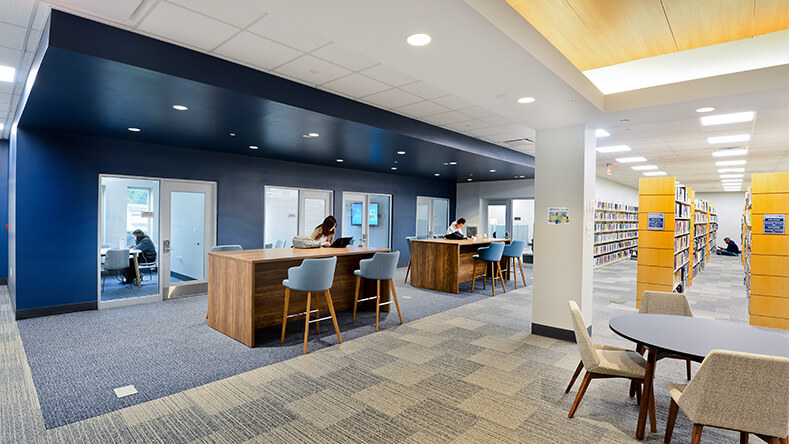
DMR transformed 15,000 SF of dated space into a dynamic multi-generational hub. A former computer lab became a teen innovation zone and makerspace, now home to 3D printers, textile equipment, and creative technology. The expanded History Room celebrates Middletown’s Revolutionary War legacy, now four times its original size and enhanced with interactive displays and curated artifacts.

The renovation also added four private study rooms, an inviting fireplace lounge, and a more open, naturally lit floor plan with flexible seating for all ages.

“The new design was created to meet the needs of our ever-growing Middletown community so we can better serve them,” said Business Manager, Wendy LaTona “This library isn’t just for reading—it’s where neighbors connect, where teens explore new ideas, and where our town’s deep rooted past is honored in a space built for its future.”

Essex County College – Dr. Martin Luther King Jr. Library & Learning Center
In Newark, DMR’s design repositioned the 18,000 SF library as the heart of campus life. The project relocated the Learning Center into the space, integrating AI-enabled academic tools, collaborative tutoring zones, and a custom bookcase honoring Dr. King as a visual and emotional anchor. Clerestory windows were re-opened to flood the space with light, while floor-to-ceiling glass storefronts created a transparent and welcoming entry.

“We wanted students to walk in and feel that this was their space,” said Essex County College President Dr. Augustine Boakye. “This library gives students a sense of belonging. It reflects the diversity, resilience, and ambition of Essex County College—and it honors the legacy of Dr. King by creating a space where opportunity, learning, and equity come together.”

“The new design has brought a real energy to the space—it’s being used more consistently throughout the day by students and faculty,” said Mohammed Seddiki, Executive Dean & Chief Information Officer of Essex County College “The layout and openness make it easier for people to focus, collaborate, and feel comfortable using the library in different ways.”

Real-World Results Back the Design Strategy
According to a Federal Reserve study, public library renovations are linked to:

  • A 21% increase in children’s book checkouts
  • An 18% increase in children’s attendance at programs
  • A steady rise in reading test scores over seven years

Additional case studies show circulation often increases by more than 50%, with new users engaging in programs for the first time. “Design is what transforms a library into a vital part of the community,” said Pradeep Kapoor, AIA. “The way a space is laid out—how it invites people to gather, study, or simply spend time—directly impacts how it’s used. Our goal is to create environments that support how people learn, connect, and grow today.”

These projects build on DMR’s continued work across New Jersey, including the Montgomery branch of the Somerset County Library System, and showcase the firm’s leadership in public infrastructure that is responsive, inclusive and forward-thinking.


DMR Launches Construction Management Division to Expand Client Service and Project Delivery

DMR Launches Construction Management Division to Expand Client Service and Project Delivery 789 444 DMR Architects

DMR announced the official launch of its Construction Management Division, further strengthening the firm’s ability to support clients through every phase of project delivery. The new business line brings construction management, owner’s representation and project management services under the same roof as one of New Jersey’s most established architecture firms.

Whether acting as owner’s representative or managing construction on third-party designs, the team brings a depth of architectural understanding to ensure quality, efficiency, and adherence to the client’s vision.

The team includes licensed and certified professionals with backgrounds in construction management, general contracting, cost estimating and architecture. This expertise allows the team to approach each project with a deeper understanding of drawings, specifications and solutions that maintain design intent while proactively addressing field conditions.

“By offering construction management independent of our architectural services, we can protect our clients’ interests at every step, make smarter decisions in the field, and ensure every project reflects the quality and integrity that DMR is known for,” said Pradeep Kapoor.

The team will lead quality control tasks, negotiate with contractors, resolve issues in real time and enforce contract documents to support adherence to schedule, budget and code requirements. The division is also experienced with advanced construction technologies including drone videography and mobile project management tools.

The Construction Management Division is led by Henry B. Ossi, a 20-year veteran who is a certified cost estimator, a licensed building official, and has worked as a general contractor and an interim school business administrator. His diverse background allows him to approach projects from the owner’s perspective and with a firm command of constructability, budgeting and regulatory review.

“We are proud to introduce this division, comprised of a team with a wide range of credentials and practical experience,” added Kapoor. “Their leadership in the field will allow us to deliver successful outcomes for the most complex projects.”

Ribbon Cutting Celebrates Major Expansion at John P. Stevens High School

Ribbon Cutting Celebrates Major Expansion at John P. Stevens High School 789 444 DMR Architects

The Edison Township Board of Education recently marked the completion of a $30 million project that consists of a new classroom wing and fully renovated auditorium at John P. Stevens High School, marking a significant milestone in the district’s facilities improvement program.

The expansion at J.P. Stevens is part of a comprehensive initiative to upgrade school facilities across the Edison School District. With multiple projects in progress or recently completed, the district is focused on expanding capacity and enhancing the student experience with modern, flexible, and forward-thinking educational environments.

The new 50,000 SF classroom addition at J.P. Stevens was carefully integrated into the existing campus, allowing school functions to continue uninterrupted during construction. The project includes 30 new classrooms, a dedicated orchestra room, and innovative learning spaces such as a reconfigurable classroom that can expand from 850 to 3,400 SF and a collaborative stepped seating area known as a “learning stair.” A 3,000 SF renovation to the auditorium provides enhanced performance capabilities and dynamic opportunities for both instruction and community engagement, including the ability to adjust from a traditional to thrust stage set-up.

“Improvements such as these reflect our ongoing investment in the future of Edison’s students,” said Jerry Shi, President of the Edison Township Board of Education. “By creating spaces that support how students learn today—and how they’ll learn tomorrow—we’re positioning our district for long-term success.”

“These projects represent the district’s dedication to fostering a culture of learning that’s adaptable, inclusive, and empowering for every student,” said Dr. Edward Aldarelli, Superintendent of Edison Schools. “We’re creating environments that reflect the evolving needs of education, support our incredible teachers, and inspire our students to reach their full potential.”

“At J.P. Stevens, our goal was to create an environment that supports educational excellence and gives students and teachers the flexibility to grow,” said Pradeep Kapoor. “We’re proud to contribute to a district that is making bold, future-minded investments in learning spaces.”

Other completed projects in the Edison building program include renovations and additions at Thomas Jefferson and Herbert Hoover Middle Schools, a new music studio at John Adams Middle School, a kitchen upgrade at James Madison Primary School, and new classrooms at Woodrow Wilson Middle School.

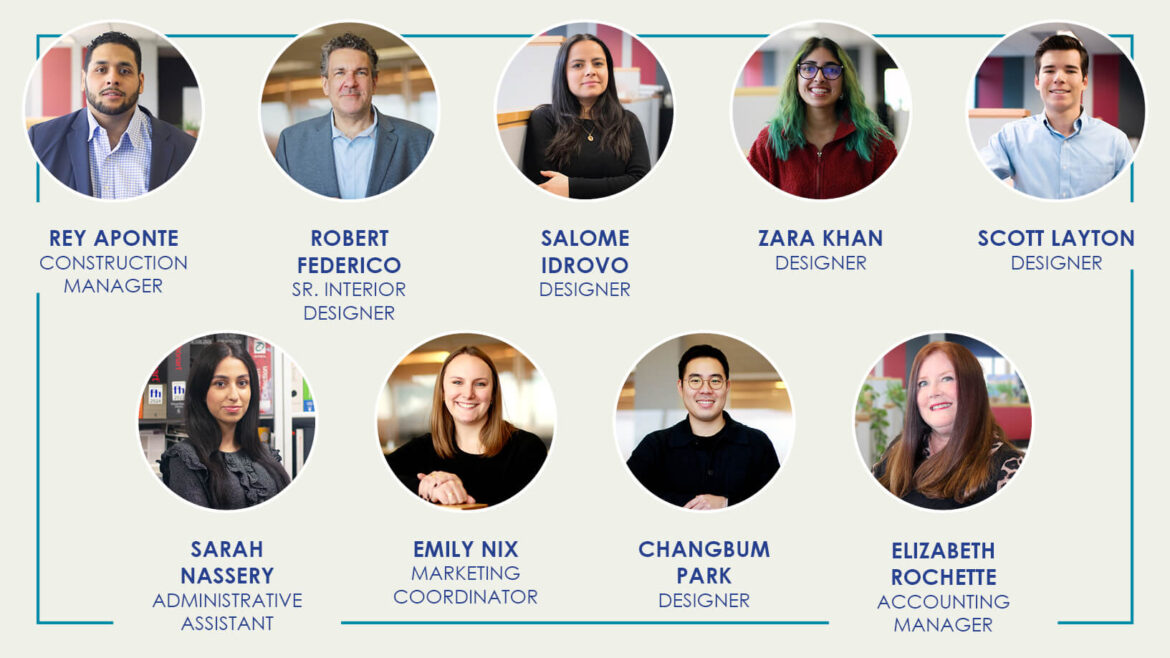
Headshots of nine hires at DMR Architects in the last year.

DMR Showcases Commitment to Talent Development in a Competitive Hiring Environment

DMR Showcases Commitment to Talent Development in a Competitive Hiring Environment 1633 925 DMR Architects

Amid a challenging hiring landscape for architecture and engineering firms, DMR has welcomed nine new team members over the past year, reflecting our long-term commitment to mentorship, career development and cultivating talent from within.

The new hires span departments including architecture, interiors, construction administration, marketing and operations – showcasing a mix of seasoned professionals and early-career talent.

“We believe great design starts with great teams,” Pradeep Kapoor, AIA said.  “We’re proud to be growing – not just in size, but in the quality and character of the people joining our firm. Providing mentorship and opportunity has always been central to our culture, and it continues to bring fresh energy and ideas into our work.”

Congratulations to the following team members on their hiring at DMR:

  • Rey Aponte, Construction Manager
  • Robert Federico, Senior Interior Designer
  • Salome Idrovo, Designer
  • Zara Khan, Designer
  • Scott Layton, Designer
  • Sarah Nassery, Administrative Assistant
  • Emily Nix, Marketing Coordinator
  • Changbum Park, Designer
  • Elizabeth Rochette, Accounting Manager

Designed Relevance and Reverence: 10 Transformational DMR Projects That Continue to Shape the Region

Designed Relevance and Reverence: 10 Transformational DMR Projects That Continue to Shape the Region 789 444 DMR Architects

With more than 5,000 projects completed over its 34-year history, DMR has left a lasting imprint on New Jersey’s architectural footprint. Great communities are anchored by strong systems of transportation, education, and healthcare, and DMR has played a vital role in shaping each of these across our region. Many of the firm’s projects continue to perform exactly as envisioned, while others have been revisited and enhanced over time to meet evolving user needs and respond to changing regional contexts.

“It is especially rewarding to be brought back to a property years after having designed it to make changes that extend its life,” says Lloyd Rosenberg. “We return to find that not only does the building need to address new considerations of the user, it also is responding to fundamental issues occurring in the industry, immediate surroundings, and broader region.”

The following 10 projects exemplify how thoughtful, future-ready design can support not only a building’s long-term performance, but also its evolving role within its surrounding environment.

  1. Annin Lofts

One of Russo Development’s first residential projects, Annin Lofts in Verona is the site of the Annin Flag factory, which was redeveloped, and a new structure that was similar in scale and reminiscent of the design of the original building.

“Annin Lofts was unique in the Russo portfolio because it was our only adaptive re-use project, but it also demonstrated one of our core values of tapping into demand for luxury housing in unexpected locations,” says Ed Russo, president of Russo Development. “Its appeal to renters in the Essex County suburbs only gets stronger with time, and much of that has to do with the project’s innovative blending of old and new.”

  1. Tenafly School District

DMR is an expert at supporting referendum-based school projects across New Jersey, helping pass more than $300 million in funding that has delivered new schools in Sparta, Carlstadt, Carteret and Franklin Lakes. DMR also helped pass three referendums in Tenafly, first in the early 2000s and then again in 2024. These long-standing relationships highlight DMR’s trusted role in helping school districts plan, communicate, and deliver impactful educational environments supported by their communities.

The current $76 million Tenafly project series prioritizes improved instructional spaces, security and ADA accessibility across six schools plus the Geissinger Athletic Complex and the district’s offices.

“A lot has changed in education in just the past two decades and investing in upgrades is imperative to New Jersey schools if they want to remain competitive,” said Pradeep Kapoor. “That goes for classrooms but also extracurricular and sports activities that may not have existed in the early 2000s like STEM programs and pickleball.”

  1. Robert Wood Johnson Campus

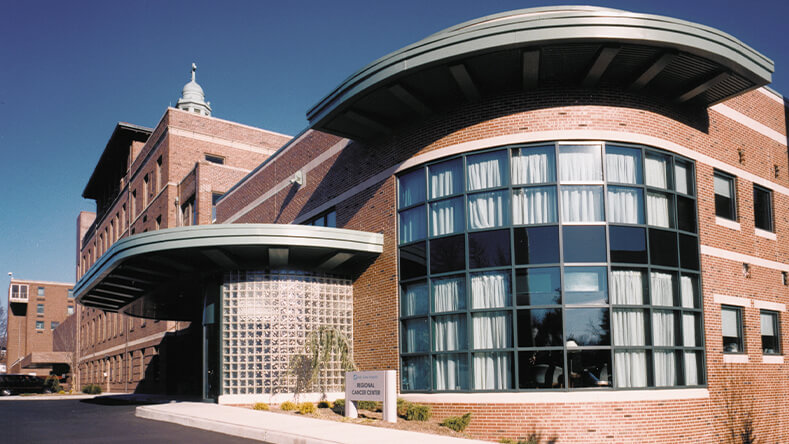
Tenafly is not the only entity to retain DMR over multiple time periods. DMR has a long-standing track record in designing healthcare and specialty treatment facilities. While DMR’s work includes notable projects such as the Holy Name Cancer Center—originally built two decades ago and still serving the community—its longstanding relationship with Robert Wood Johnson University Hospital exemplifies the firm’s ability to adapt to the rapidly changing demands of healthcare environments.

Technology has a dramatic effect on architecture, but no more so than in the healthcare space. When DMR introduced New Jersey’s first PET scan lab at Robert Wood Johnson hospital the landscape was yet to be transformed by the series of mergers–and innovations–that have come to define today’s healthcare environment.

Other DMR projects on RWJ’s campus included offices, labs, outpatient offices and nurse’s stations.

  1. St. Joseph’s School for the Blind

St. Joseph’s School for the Blind in Jersey City retained the firm in 2005 to build a new school, as their 1927 Concordia Learning Center had become too small to address the growing needs and evolving program of the school and accommodate students with multiple disabilities. The result was a 73,000 SF facility with 17 classrooms, a multi-purpose gymnasium/auditorium, a multimedia center, therapy and work rooms, a physical therapy pool, an adaptive playground, and music, art and pre-vocational classrooms.

The building was one of New Jersey’s first LEED certified private schools and also DMR President Pradeep Kapoor’s first LEED Certified project, the catalyst to a portfolio that has grown to include seven Certified, Silver and Gold level projects.

“LEED certification at the time of the original construction was a pioneering feature that allowed DMR to be among the first to explore environmental issues that have become a required consideration, whether the owner seeks the designation or not,” said Mr. Kapoor. “Sustainability is in the DMR DNA and a lot of that traces back to St. Joseph’s.”

  1. Blue Foundry Headquarters

Blue Foundry Bank engaged DMR to design its new administrative headquarters as it relocated from downtown Rutherford to Morris County in 2021. The project not only needed to embody the bank’s evolving brand identity but also required mid-course workspace adjustments to address pandemic-related concerns.

“The aesthetic and functionality of our new administrative headquarters serve as symbols of the bank’s renewed business focus and vision,” says Blue Foundry Bank President & CEO Jim Nesci. “It was essential for us to align our physical space with our brand, and a tour of our offices clearly shows how the bank’s image is thoughtfully crafted into nearly every aspect of the design.”

  1. Jersey City Justice Center

Jersey City’s Justice Center at 365 Summit Avenue originally opened in 2001 and has shown itself to be a durable facility and an iconic venue for the City’s courts and offices for judges, prosecutors and staff.

“We designed the Justice Center to meet the needs of the City at the time, but also with enough flexibility to grow with it,” said Lloyd Rosenberg. “It’s rewarding to see how well the building has adapted over the years to support new technology, procedures, and expanded use without losing its original purpose.”

  1. Wayne Police Department

When Mayor Chris Vergano spearheaded the municipality’s development of a new police station in 2012, the objectives extended beyond accommodating the growth of the department and the introduction of new policing tactics and technology. The final design balances function and civic presence with clearly defined operational zones, and spaces that support both law enforcement and community interaction.

“Our goal was to create a facility that supported the department’s operational needs while also projecting openness and accessibility to the community,” said Kurt Vierheilig. “We worked closely with the Township to develop a design that could evolve with the way public safety services are delivered over time.”

  1. Meadowlands Sports Complex Train Station

The train station at the Meadowlands Sports Complex was an enhancement related to the construction of what became American Dream and was a critical consideration of the Stakeholder Committee that was convened to assess the impacts of the development on the community.

“The Meadowlands Station was a forward-thinking investment in the region’s future,” said Jim Kirkos, president of the Meadowlands Chamber and a member of the Stakeholder Committee. “The talent and vision of DMR Architects added critical mobility to the complex via the design of the train station and helped lay the groundwork for major regional wins—from hosting the Super Bowl and WrestleMania to securing the 2026 FIFA World Cup.”

  1. Carteret’s New Junior High School

In Carteret, DMR designed the new 60,000 SF Junior High School after a site planning exercise that resulted in locating the building on a property adjacent to the town’s high school. Funded through a referendum that DMR guided, plans also included a pedestrian bridge between the Junior and Senior High Schools so that the schools could share a newly renovated auditorium.

The project was the starting point for Carteret to hire DMR for additional work throughout the district including a redesign of the high school’s main entrance that served to provide the building with an identity and visual impact while increasing security measures.

  1. Bergen PAC

DMR has worked on notable historic preservation projects, including enhancements and design improvements to the iconic Bergen Performing Arts Center. The renovation transformed the beloved 1,300-seat theater, originally opened in 1926, into a modern venue capable of hosting nearly 200 events annually. The project included a full renovation and expansion of the existing lobby and the addition of a new VIP room featuring two bars and a private entrance.

To honor the building’s legacy while appealing to a contemporary audience, DMR blended raw industrial design elements, such as exposed beams, brick walls, pendant lighting, and visible ductwork, with the refined traditional finishes expected in a classic theater. The result is a dynamic, updated space that respects the theater’s historical character while meeting the demands of today’s diverse performing arts audiences.

“DMR Architects did an incredible job transforming our historic theater. Their design preserves the character and legacy of bergenPAC while introducing modern features that elevate the experience for both performers and audiences,” said Alexander Diaz, Executive Director at Bergen PAC. “It’s a renovation that honors our past and supports our future.”

A gym addition at New Brunswick High School provides additional space for physical education and sports.

In PreK-12 Design, The Right Architectural Partner Completes the Team

In PreK-12 Design, The Right Architectural Partner Completes the Team 789 444 DMR Architects

Of the more than 1,000 educational projects completed by DMR Architects, more than 80% can be categorized as reinvestment relationships that have spanned decades, touched most of the districts’ buildings and guided the community through major moments.

DMR has supported at least 30 districts through 25 projects each, a window into the role that an architect plays in the process of providing modern, safe and stimulating infrastructure for learning.

While our architects are also the visionaries behind celebrated new construction, most preK-12 school needs fall into the category of essential building upgrades, additions, health and safety concerns and other facility maintenance needs.

In addition to choosing a capable designer, choosing the right architectural partner for these projects means choosing a firm that can identify unique funding sources, comprehend pragmatic functions of the building, consider how construction projects will disrupt the existing ecosystem and examine every opportunity for a chance to improve functionality.

A sampling of some of these holistic stories include:

20 Years Later, DMR Returns

Between 2000 and 2005, DMR provided extensive services for the Tenafly Board of Education, helping to pass two referendums totaling $44 million to fund projects at all schools. In 2022, DMR was retained for the second time as the district sought to again bring all of their facilities up to modern standards.

DMR was tasked with the process of identifying hundreds of needs, consolidating needs gathered by administrators, previous professionals and DMR’s own surveys; developing a cost estimate for hundreds of projects; and identifying how projects could be organized to maximize funding sources, including through an Energy Savings Improvement Plan (ESIP); Elementary and Secondary School Emergency Relief (ESSER) funding; the district’s capital reserve; and what became a $76 million public referendum, which passed in September 2024.

A Relationship Delivers Projects for 15 Straight Years

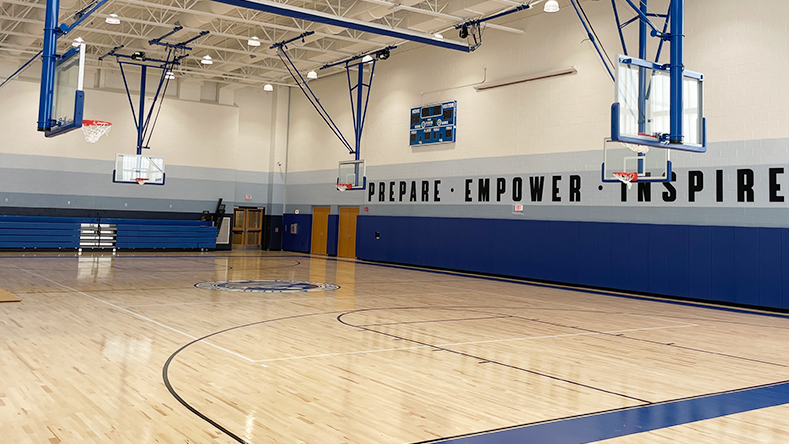
As Architect of Record since 2008, DMR has provided professional services for nearly 50 projects in New Brunswick, projects that range from plans and assessments that have required the examination of every square foot of every building, to working on the development team that delivered the new Blanquita B. Valenti Community School. In between these projects have been HVAC and mechanical upgrades, fields, masonry repairs, a $9 million renovation of a former parochial school into Board of Education offices and a $6 million gym addition that was championed for more than a decade.

30 Projects Delivered Without Taxpayer Increase

DMR first began working with the Hackensack Board of Education in the early 2010s, completing a number of major projects such as an emergency reconstruction when a portion of Fanny Meyer Hillers School was deemed unsafe for occupancy.

Years later, DMR was retained again by the Hackensack Board of Education, this time following a failed $170 million referendum by a previous team. While the referendum did not receive the funding that would have made it possible, upgrades across the district were still desperately needed. Since 2019, DMR has supported the district through more than 30 projects valued at more than $45 million. Many of these projects were initially part of the failed referendum, but were able to be delivered through creative funding mechanisms including an ESIP and ESSER funding.

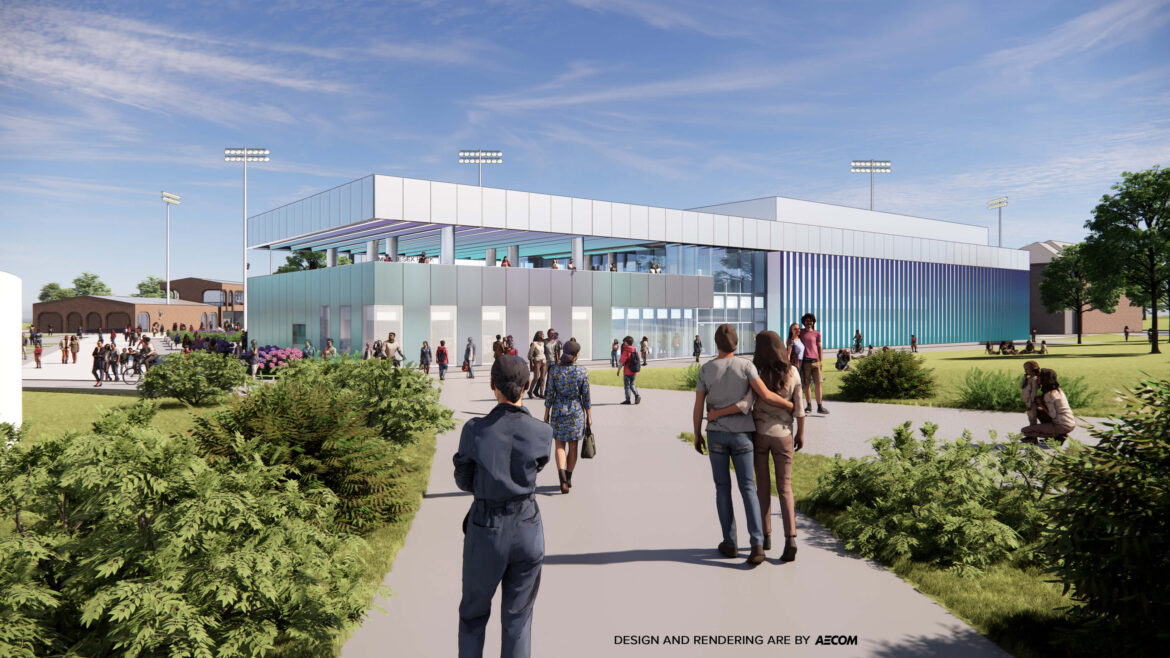
A rendering shows what the new Middlesex College Student Center will look like. The metal exterior includes an iridescent coating that changes hues. Another notable feature is the large exterior terrace.

DMR to Deliver Space for Expanding Culinary Program at Middlesex College

DMR to Deliver Space for Expanding Culinary Program at Middlesex College 2560 1450 DMR Architects

The transformation at Middlesex College continues with a new 30,000 square foot Student Center, signaling its momentum in an education market that is responding to new demands from students, new technology, and lifestyle and career cycles.

Together with a Multipurpose Community Venue and the new Middlesex County Magnet School, the Student Center is part of the County’s Community, Innovation, and Opportunity Strategic Investment Plan.  DMR Architects is the Architect of Record for the Student Center while AECOM is the Design Architect for the Student Center and the Architect for the Multipurpose Community Venue.

In addition to featuring student meeting and study spaces, a game room, and a restaurant, the new facility will house an expanded culinary arts program that will offer two new labs—doubling the capacity of the program—as well as adding a terrace for events.  It will also give students hands-on service experience at its restaurant with indoor seating as well as the Multipurpose Community Venue, a 6,500 capacity sports and event facility, that is expected to break ground this fall.

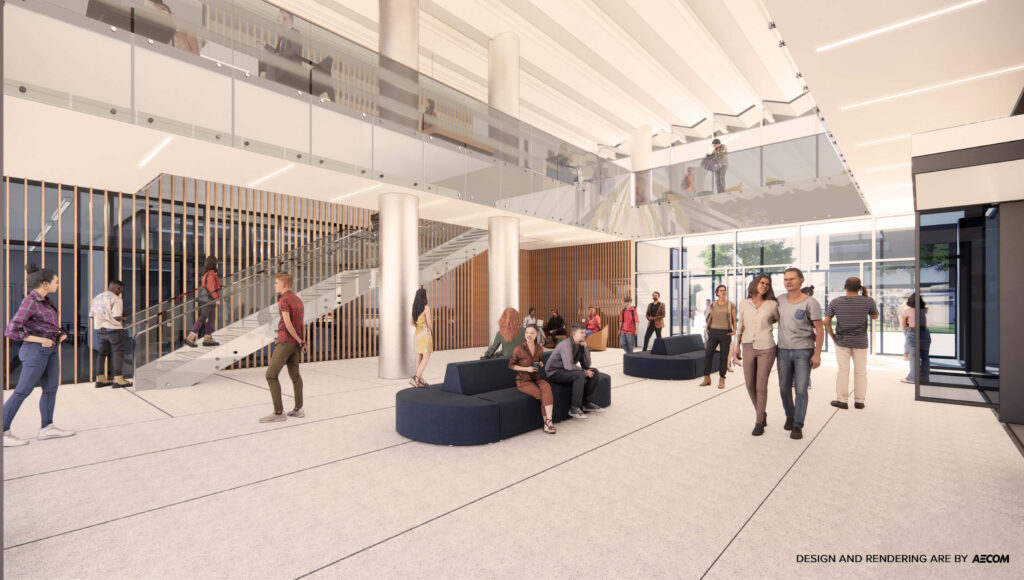
A rendering shows what the main lobby of the Middlesex County student center will look like.

“The CIO Plan isn’t merely an aspiration or a ‘hope’ of ours, it’s a reality,” said Middlesex County Commissioner Director Ronald G. Rios. “For all of us who call Middlesex County home, the CIO strategy will be a game-changer in our economy and the quality of our lives – this includes improving the lives of students, faculty, and staff that work and attend Middlesex College.”

“This is our fifth project with Middlesex College,” said Pradeep Kapoor, AIA, LEED AP BD+C.  “Middlesex County’s investment in higher learning exemplifies that education is a robust development area in New Jersey’s landscape to entice local students to stay in-state with unique offerings in engaging spaces.”

DMR’s work at Middlesex College also included the 2016 design of West Hall and the 2011 design of David B. Crabiel Hall totaling more than $20 million in construction value.

The 32,000 square foot West Hall was designed to support the school’s complete change to its business model into a student services model and became the central event space on campus.

The 36,000 square foot Crabiel Hall was the first new construction building in the prior decade, kicking off the tremendous proceeding development of the campus, while adding functional, social and educational space.  It was also the first of green building on campus and served as a place maker, creating a new gateway onto campus.