
News

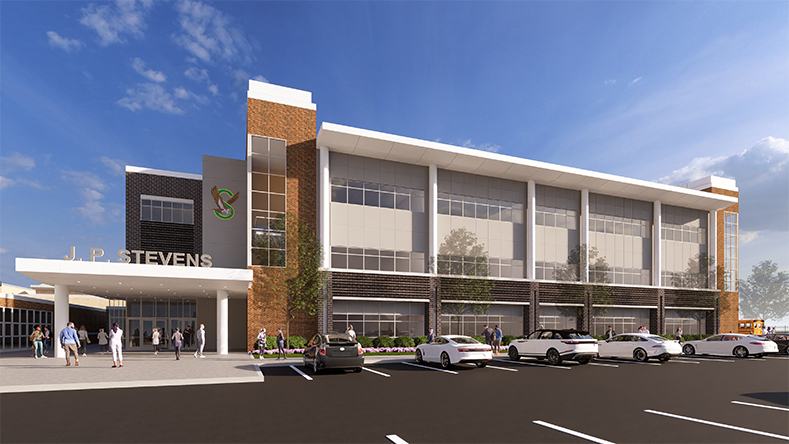
A rendering shows what the addition to J.P. Stevens High School will look like.

Edison BOE Moves Forward with $100 Million in Projects

Edison BOE Moves Forward with $100 Million in Projects 789 444 DMR Architects

A Nov. 1 groundbreaking ceremony marked the commencement of a 48,000 SF DMR-designed classroom addition at J.P. Stevens High School in Edison. It is part of a $100 million investment by the Edison Board of Education at six of its facilities.
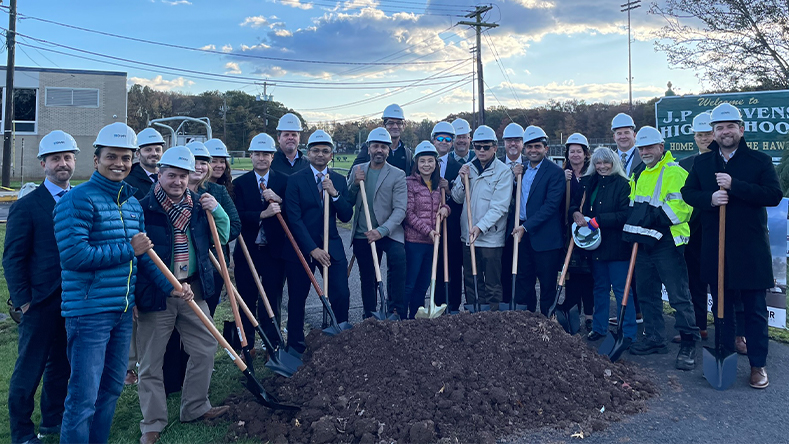
“Working closely with the district, DMR designed these spaces to improve the education-related experience for the students that utilize these buildings,” said Kurt Vierheilig, AIA, LEED AP BD+C.  “We commend Dr. Aldarelli and the school board for advancing improvements to their facilities which will improve the learning and development of their students.”

The projects will be phased over several years to reflect current technologies, changes in education strategies, and address the dynamic increase in New Jersey’s sixth largest municipality’s school-aged population.

“The Edison school system is well-known for its high academic standards and ability to prepare students for post-graduation studies and careers,” said Pradeep Kapoor, AIA, LEED AP BD+C.  “The work we’re doing will assist teachers and students in their pursuit of the best education practices.”
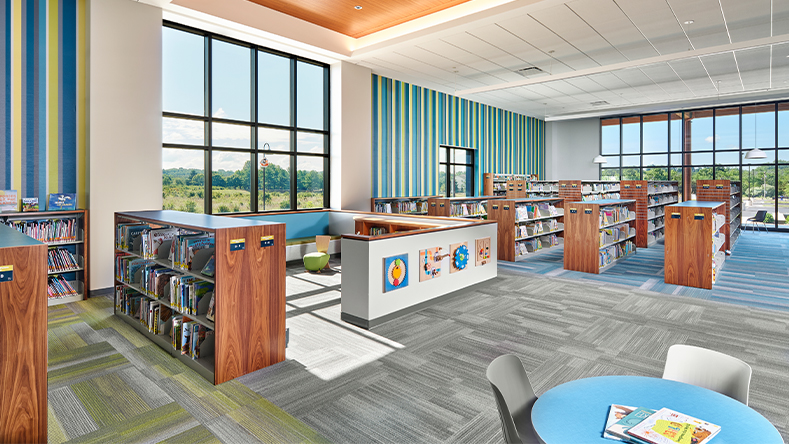
 

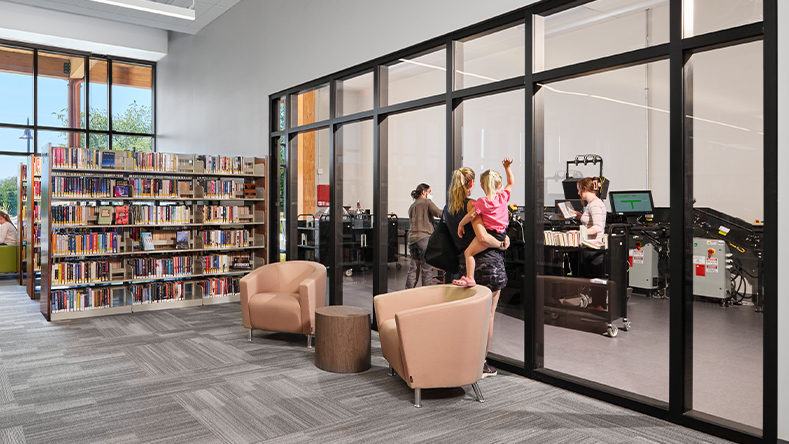
The children's room at the Montgomery branch of the Somerset County Library System includes bright colors, patterns, age-appropriate games and small gathering areas.

Montgomery Library Featured Among Country’s Most Celebratory Libraries

Montgomery Library Featured Among Country’s Most Celebratory Libraries 789 444 DMR Architects

The Montgomery branch of the Somerset County Library System is among vibrant, celebratory and stimulating libraries across the country that were featured in Library Journal’s Architecture Issue.

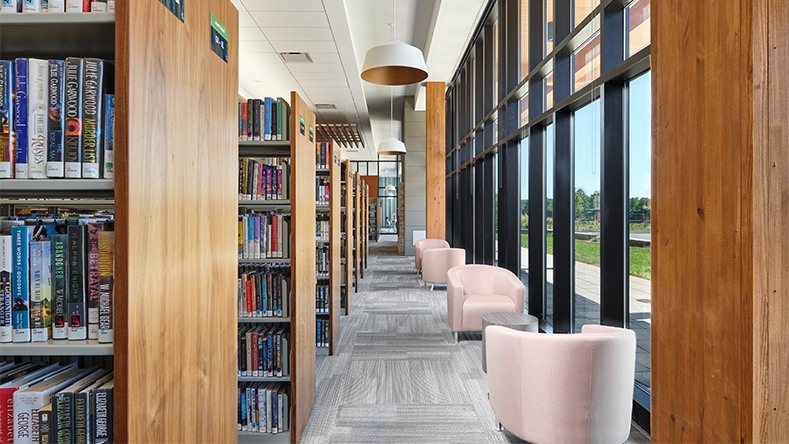
The exceptional design of the branch, built as part of the design and construction of a new municipal center, focused on providing a modern space that met the varied social and intellectual needs of the community, while also honoring the township’s history as an agricultural community.

Design features implemented in pursuit of this goal include:

  • The main “living room,” with a fire feature and soft furniture for casual reading. Seating is also located along the full height, glazed façade which overlooks the surrounding landscape, primarily open space, and connecting the patrons to the outside. The use of heavy timber throughout the exterior and interior is also a tribute to the township’s agricultural history.
  • A sort-o-matic, a book sorting machine. Special design considerations were taken for patrons to enjoy watching their books move through the grand piece of machinery.
  • A digital preservation lab, equipped with a large format archival scanner, advanced video and audio editing technology, a light box for photographing historical objects and access to many other digital programs. Designers strategically placed this room in a central location and utilized glass walls to maintain visual connection.
  • Additional technological integrations, including reserving materials online to after-hours pickup from an outdoor book locker.

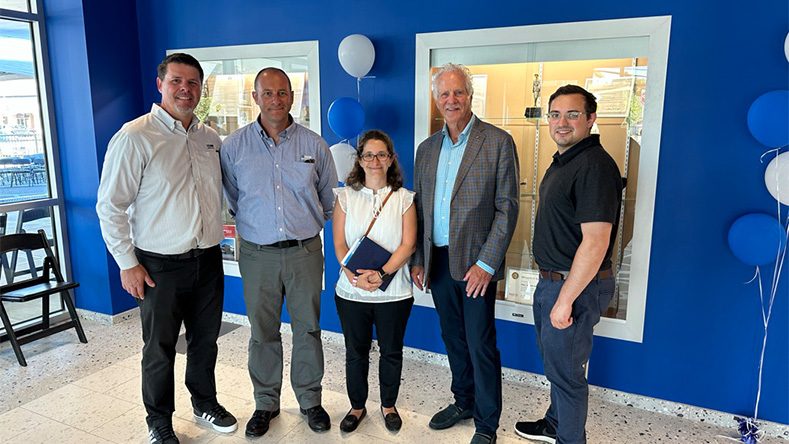
Members of the DMR Architects team pose in the lobby of the Blanquita B. Valenti Community School at the ribbon cutting event.

Construction Milestones at DMR-Designed Schools Reveal Unique Funding Sources and Delivery Methods

Construction Milestones at DMR-Designed Schools Reveal Unique Funding Sources and Delivery Methods 789 444 DMR Architects

DMR has recently participated in construction milestone celebrations in four New Jersey municipalities, delivered through a variety of funding and procurement methods for projects that enhance the learning experience for school-aged children while also being fiscally responsible to residents.

In Carteret, sixth through eighth grade students recently began their second year in the new DMR-designed Junior High School.  This is the successful culmination of a project that started with a referendum to build the first new education facility in the borough in 40 years.  DMR played a key role in creating and presenting materials to residents about the need for a new school as well as the benefits to taxpayers.

“Our work in Carteret included adjusting the program to make sure that we adhered to a strict tax dollar value that was palpable to residents as well as selecting projects so that its five schools and all 4,000 students benefited from the referendum,” said Lloyd Rosenberg, AIA. “DMR was also involved in strategic planning with the Carteret School Board and Mayor on finding the best site for the new Junior High School that fit its educational needs and budget.”

In Plainfield, the DMR-designed Charles and Anna Booker Elementary School was constructed through the New Jersey Schools Development Authority design-build program. This is the first year for 700 K-fifth grade students to matriculate in the facility that replaces the outdated Woodland Elementary School with 41 classrooms in addition to rooms for science demonstrations, a technology lab, a media center, physical therapy, a speech room, a cafetorium, a multi-purpose room with a stage, a playground, and basketball courts.

The design-build method will also be used to fund the construction of Hudson County Vocational at Bayonne High School, a project for the Hudson County Schools of Technology, Bayonne Board of Education, Hudson County, and the Hudson County Improvement Authority.  DMR is the architect of record for the project which recently broke ground and will provide vocational and career technical education in mechanics, construction, carpentry, plumbing, electrics, finance, digital communications, criminal justice, cosmetology, and medicine.

In New Brunswick, the DMR-designed Blanquita B. Valenti Community School just opened replacing the Lincoln Annex School, formerly St. Peter’s High School and Elementary School, which was demolished for construction of the state’s first free-standing cancer hospital.

“This was a very unique situation where the building had outgrown its benefits to the city but the land underneath it was valuable enough to fund a new state-of-the-art educational facility that will shape the minds of students for generations to come.”

DMR designed the three-story, 127,000 SF facility with advanced educational spaces including a media center, technology lab, makerspace, labs, and other traditional educational spaces.

“Just as each school system requires its own customized solutions for additional space, new technologies and teaching modalities, STEM labs and spaces for extracurricular activities, they also need tailored approaches to funding.  Sometimes we take what we’ve learned working with one municipality and apply it in another because their education needs and funding barriers are similar.”

Among other funding sources for school districts is New Jersey’s Energy Saving Improvement Program (ESIP). DMR-planned projects totaling more than $35 million in Edison, Hackensack and Tenafly are currently in progress. Through the program, energy-related projects, such as HVAC upgrades and solar panels, are funded using the value of the energy savings that result from the projects so that school boards do not have to utilize municipal capital reserves or utilize taxpayer dollars.

A promotional flyer promotes the Frankie Valli performance and fundraiser at the bergenPAC and includes headshots of the two honorees.

bergenPAC Honors DMR’s Lloyd Rosenberg for his Support of Performing Arts

bergenPAC Honors DMR’s Lloyd Rosenberg for his Support of Performing Arts 789 444 DMR Architects

On Sunday, October 15, Lloyd Rosenberg, AIA, president and CEO of DMR Architects will be honored by bergenPAC, one of the most iconic Northern New Jersey performance spaces, for his contributions to supporting the performing arts community.

Lloyd’s prolific career includes the recent redesign of bergenPAC’s lobby, concessions/bar area and new VIP area into a vibrant gathering space.

“bergenPAC’s trust in DMR’s vision to evolve their spaces into a cohesive experience that starts long before the curtains go up was a great honor in and of itself,” he said.  “I am grateful and humbled by its recognition of our work here and throughout the region in support of the arts and thank them for all they do to advance artistic expression and make it available for everyone to enjoy.”

DMR re-energized bergenPAC using raw industrial design elements—bare beams, exposed brick, pendant light fixtures and visible ductwork—juxtaposed to the refined traditional décor expected in a theater setting. The firm also redesigned the box office to refresh its aesthetic and meet current ADA compliance and the mezzanine level to increase the number of bathrooms.

DMR has been a pioneer in activating and designing performance spaces including the award-winning repurposing of Hackensack’s 140-year-old Masonic Temple into a 224-seat performing arts center and conceptual designs for a proposed state-of-the-art renovation to the Stephen J. Capestro Theatre Complex. DMR’s portfolio also expands to high schools, inspiring the next generation of performers and theatre technicians. Ten recent auditorium renovations are breathing new life into six districts by not only offering the equipment and technology to support advanced technical production and performance space, but also by bringing the often decades-old spaces up to proper compliance.

In addition to restoring historically significant theaters, DMR also redesigned historic buildings including the Annin Flag Factory into modern loft-style apartments in Verona, NJ.

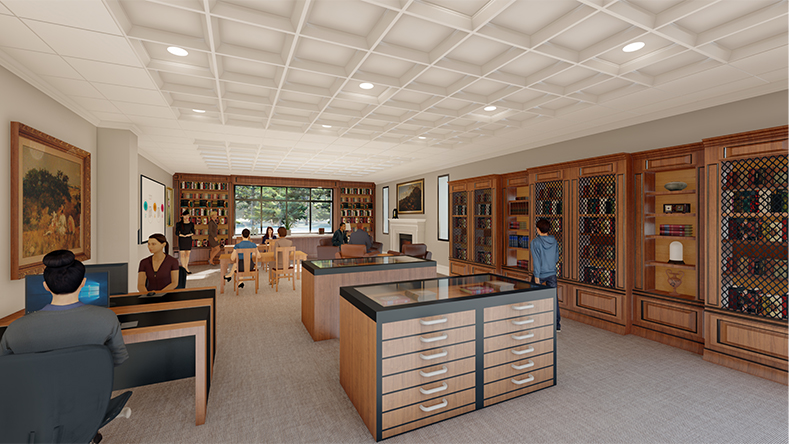
A rendering shows what the history room at Middletown Library will looks like, with rich colors and an abundance of display shelfs showing local historial artifacts.

In Middletown, Renovation Reflects Social Identity of the Library

In Middletown, Renovation Reflects Social Identity of the Library 789 444 DMR Architects

While libraries have always served as hubs of curiosity and enlightenment, changes in technology, resources and styles have called for many renovations. Middletown is the latest municipality to turn to DMR to renovate their public library to address these modern needs.

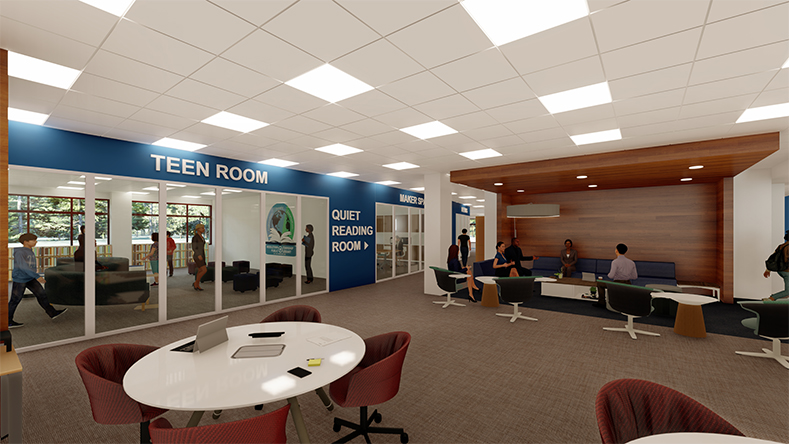
DMR’s plans at the Middletown Library will soon reshape the facility into a destination that will better serve the social and intellectual needs of the town through new and expanded programming space including a makerspace and business skills lab, café/coffee station with a fireplace lounge, and dedicated history, teen, reading and community rooms. The design considered visual connection, existing natural light and overall flexibility.

Previously, DMR helped fund library projects in numerous municipalities and completed projects in Montgomery, which received national recognition, and for the North Hunterdon Regional High School District.

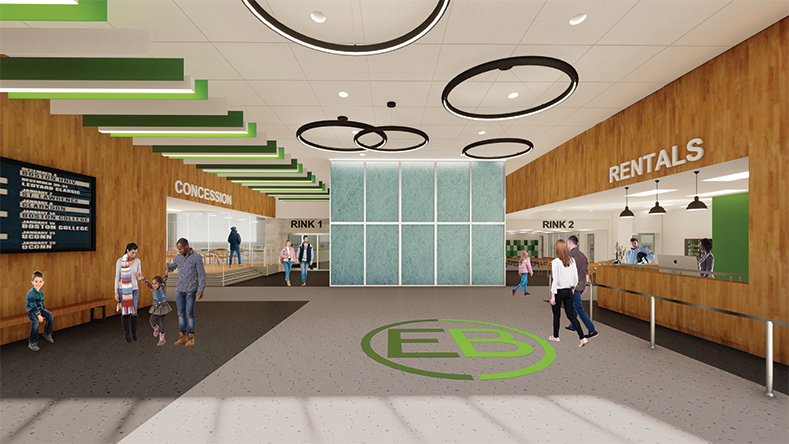
A rendering shows what the interior lobby of the East Brunswick Ice Rink will look like, including a stairwell clad in translucent panels, meant to mimic an ice cube.

Where’s the Party? It’s In Your Lobby

Where’s the Party? It’s In Your Lobby 789 444 DMR Architects

Pre-COVID-19, public spaces – everything from waiting rooms to bank branches – were quickly evolving into engagement space that encouraged interaction between employees and visitors.

While COVID caused many businesses to rethink spacing, counterintuitively, it hasn’t been about reduction or elimination of gathering areas.

Or, said differently, organizations of all types might as well be saying “Let’s get this party started.  Again.”

DMR Architects explains:

“Common areas should not be used simply as comfort and waiting stops, they should stimulate relationships among their visitors – whether that be a full-time employee walking through or a customer who may visit very infrequently.  The idea of fostering relationships and making people feel wanted, comfortable and entertained has enormous value – and it can be accomplished for a modest investment,” said Lloyd A. Rosenberg.

DMR has executed public space strategies for a wide array of companies. Some, like Blue Foundry Bank’s administrative office, were commenced before the pandemic and others, like Ridgefield’s municipal offices, were designed during the pandemic.  Each is responsive to a different set of criteria in pursuit of a specific objective. But they all have one thing in common: they are easy places to be.

“A generation ago, waiting rooms and reception areas were sterile places that people wanted to leave and meeting rooms were dominated by conference tables and uncomfortable seating,” Lloyd Rosenberg continues.  “Whereas in the past you were lucky to have coffee service, at Blue Foundry one of the main meeting spaces is a lounge-style cafeteria with beer on tap. Companies know that the more people are interacting the better they perform as collaborators. And in places like sports venues, such as the East Brunswick Ice Rink, the focus on food service and meeting spaces has transformed their use.

“And that’s all the more important since the pandemic, when people were intentionally kept apart and may be out of practice at socializing with customers and teammates.  The expected functions of an architect – like addressing circulation, capacity, wayfinding and safety – are in support of a broader consciousness.”

Even libraries and police departments are getting into the act.

“You wouldn’t think librarians would emphasize the need for places to gather, but libraries express community and culture through their public spaces, which is brought to life in the exceptional design of the Montgomery branch of the Somerset County Library System.  And in both Ridgefield and Montgomery, where the stationhouse adjoins the municipal building, the designs address practical and security concerns but are welcoming and accessible.

“These are not just buildings, they are representations of culture and community, and they should be developed as sources of pride.  And, they can be a lot of fun.  Now, it’s not a coma-inducing waiting room – it’s a party in the lobby.”

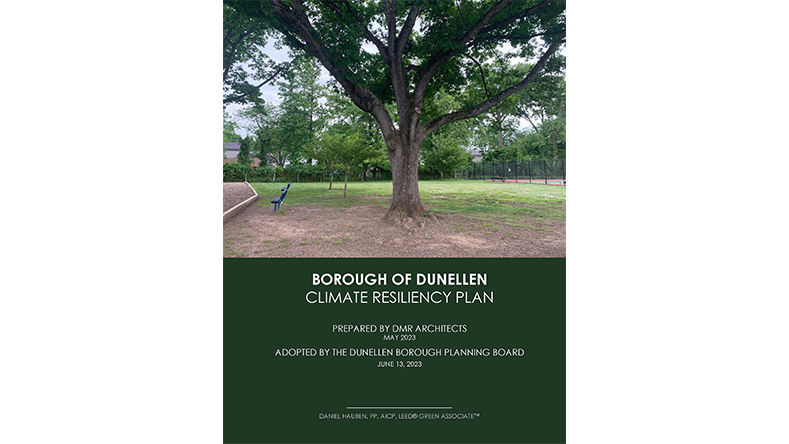
The cover of the Dunellen Climate Resiliency report.

Dunellen Among First NJ Municipalities to Adopt Climate Resiliency Plan

Dunellen Among First NJ Municipalities to Adopt Climate Resiliency Plan 789 444 DMR Architects

Dunellen is believed to be the first municipality in New Jersey to adopt a stand-alone Climate Resiliency Plan following Governor Murphy’s 2021 amendment to the Municipal Land Use Law. The borough retained DMR to write the plan which addresses its susceptibility to flooding and other global warming hazards.

“Preparing a roadmap for anticipating and avoiding the flooding and other devastation that we saw after Hurricane Ida in September 2021 is so crucial to us in Dunellen that we took the important approach to prepare this plan as a stand-alone document,” said Dunellen Mayor Jason Cilento of the plan that will be used to guide decision-making related to zoning, redevelopment, housing, infrastructure, green initiatives, pedestrian safety and other aspects of daily life and municipal governance. “DMR’s practitioners helped us complete a comprehensive, proactive and intentional plan that will advance municipal redevelopment and sustainability practices and benefit the borough for generations.”

The Climate Resiliency Plan includes recommendations to the Borough for the next decade and beyond to mitigate its exposure to worsening flooding, precipitation, and heat, such as:

  • Partnering with regional agencies and neighboring municipalities to address riverine flooding;
  • Amending local zoning and exploring other options to reduce development intensity in flood prone areas;
  • Promoting green building practices that help to reduce flooding and stormwater runoff.

“Similar to how DMR’s planners approach any project, we drew on our diverse expertise from land use and zoning to sustainability practices that will help protect Dunellen for the next decade and beyond,” said Daniel Hauben, PP, AICP, LEED Green Associate.  “It is wise for municipal leaders to plan ahead of natural disasters as we see one in a hundred-year storms making landfall more and more often.”

DMR’s work to complete the plan included:

  • Analyzing the existing infrastructure, including water, sewage, power and gas; Dunellen’s flood zones and vulnerability for flooding regardless of the designated zones; and natural hazards;
  • Completing a vulnerability assessment which examined and rated the risks facing community assets, such as brooks, parks, transit lines, and buildings;
  • Completing a build out analysis to project how much redevelopment could occur within vulnerable areas under current zoning;
  • Recommending resiliency strategies, design standards and policies;
  • Identifying grant programs to provide critical funding for the projects outlined in the plan.

DMR’s previous planning work in Dunellen also included a Master Plan Reexamination; the Master Plan, Complete Streets and Transit Friendly Planning Survey; Cannabis Business Public Survey; and numerous Redevelopment Plan amendments and other efforts to address affordable housing and infrastructure projects.

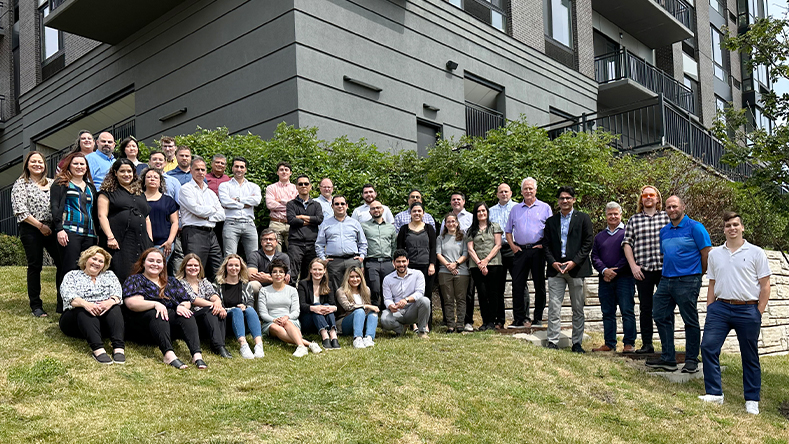
The DMR team poses for a group photo.

DMR’s Success Linked to Team’s Cultural and Skills Diversity

DMR’s Success Linked to Team’s Cultural and Skills Diversity 789 444 DMR Architects

New Jersey is the fourth most diverse state in the United States and nowhere is that more evident – or beneficial – than at DMR Architects, where more than half of the employees are naturalized or first-generation Americans.

DMR’s teams of varied voices are uniquely qualified to lead projects that are intended for vast populations including healthcare, public education and parks, municipal redevelopment plans and buildings, and residential options that range from affordable rental housing to luxury condominiums. The outcomes ensure that no one will walk in and think “this building is not for me.”

“The benefits of diversity and inclusivity are profound – we see positive impacts in a broad spectrum of expected and unexpected parts of our business,” said Lloyd Rosenberg, AIA.

“A variety of cultures creates a mixture of perspectives and that leads to greater creativity in our work – something we would expect.   But additionally, our clients come from a broad set of backgrounds, and when they respect that our organization has a value system that welcomes diversity, a comfort level ensues.”

Mr. Rosenberg, a native of Jersey City, which is among the most diverse cities in the country, observed that DMR’s structure – which features integration of practice areas – also is an allegory for diversity.

This firm’s cultural diversity is mirrored in the varied skill sets and levels of the team – and its business thrives as a result.

“In our environment, the blending of diverse professional foci is beneficial to serving our clients and to our employees’ career advancement.  It is perfectly natural that the backgrounds of our people would contribute to our culture of performance.”

There are 14 different countries of birth for DMR employees, and when their parents’ places of birth are added in, the total of 26 countries of origin is an extraordinary representation at a firm of just 45 employees.

“Architecture today should reflect inclusivity that goes beyond ADA compliance; it should have cultural compliance.  We want everyone to feel seen and heard and comfortable being themselves.”

Just as cross-practice interaction has led to outcomes that far surpassed what one mindset would achieve, cross-cultural collaborations garner far more creativity than if the firm were more homogenous.

“We’ve created the workplace composition that is necessary to get today’s projects done in a way that will continue to be relevant for generations.”

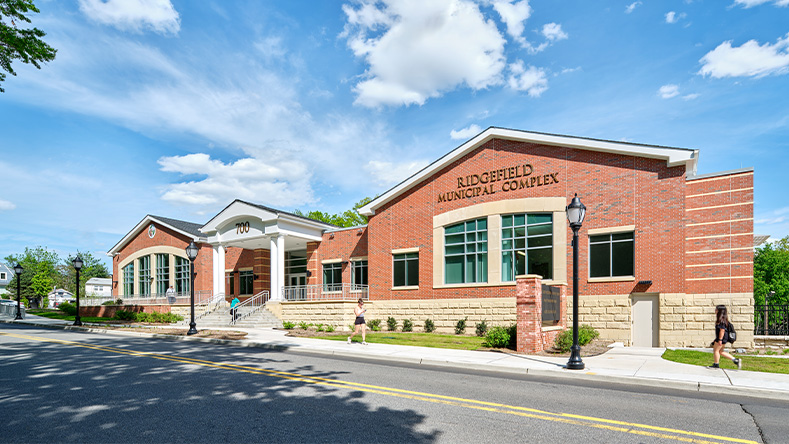
The exterior of the Ridgefield Municipal Complex.

Multiple Practice Areas Help Ridgefield Rewrite Script on Providing Municipal Services

Multiple Practice Areas Help Ridgefield Rewrite Script on Providing Municipal Services 789 444 DMR Architects

The new 27,000 SF municipal building at Shaler Blvd. and Slocum Ave. is the next chapter of Ridgefield’s reinvention story with co-author DMR Architects providing a holistic program integrating innovative planning, public project procurement, architecture, and development practices.

The new municipal building now houses the borough’s administrative offices, municipal/court chamber, and the police and building departments. The move also paved the way for the sale of the former Borough Hall, which will galvanize the Borough’s main thoroughfare through new development.

“While the need for a new Borough Hall was obvious the real challenge came in developing a unique procurement program to meet the Borough’s goals,” said Charles H. Sarlo, Esq. “DMR may be the only architecture firm in New Jersey that is structured to address what was a complex set of issues that included concerns over controlling construction costs and a due diligence process that quickly narrowed prospective locations.”

Multiple practice areas within the DMR umbrella including planners, designers, and attorneys began work in 2018 with a feasibility study of two municipally-owned properties with potential for a new development.

Ease of access, traffic, parking, size, environmental issues and the opportunity to create a public facility hub were all assessed, arriving at the ultimate solution of a site on Shaler Blvd. across from the Ridgefield Nature Center and adjacent to the Ridgefield Community Center.

DMR’s team saw the project from multiple vantage points revealing a cohesive solution for a new right-sized, municipal complex as well as assessing new uses for the former Borough Hall location that will bring in rateables and generate street-level activation in a walkable area of town.  The former Borough Hall site is in the process of being sold, creating financial resources to offset the cost of the new building.

“The corner of Shaler Blvd. and Slocum Ave. also made it a natural connection point to five acres of passive recreational space and walking trails located directly across the street,” said Janet Pini, AIA.  “The complex was constructed with energy efficient materials and technologies, and design inspiration from its location.  An expanse of windows across the back feels like an uninterrupted flow between the complex’s interior and its surrounding topography including the nearby Wolf Creek tree buffer.”

DMR assisted the municipality in having the new Borough Hall site designated as an area-in-need-of-redevelopment, providing the framework to allow greater flexibility in the procurement process.  This approach also allowed the Borough to balance risk exposure and manage project quality and costs through an alternative method rather than utilizing the traditional local public contracts law. This strategy allowed it to engage redevelopers on a maximum-cost basis that eliminated the possibility of cost over-runs while encouraging efficiency through collaboration between the architects and contractors.

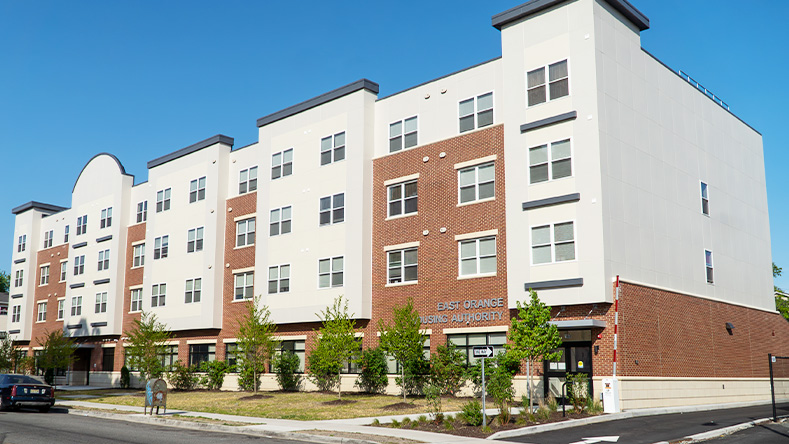
The exterior of the Ted R. Green Senior Residences, near the entrance to the East Orange Housing Authority's offices which are located inside the building.

DMR Takes Unique Approaches to Affordable Housing

DMR Takes Unique Approaches to Affordable Housing 789 444 DMR Architects

DMR has worked within numerous municipalities in New Jersey to design affordable housing solutions that become points of pride, including two projects that have recently opened: one with the East Orange Housing Authority and its partners and another in Upper Saddle River for the Bergen County Housing Development Corporation.

At the Ted R. Green Senior Residences in East Orange, DMR worked with the East Orange Housing Authority, Genesis Companies and The Metro Company to construct a 60-unit, 61,000 SF facility, with 15 units set-aside and marketed to homeless persons, in addition to 8,000 SF of administrative offices and indoor and outdoor community space.

“There is no one-size-fits-all solution to affordable housing or for inviting senior residents to age in place,” said Fernando Robledo, AIA. “In this case, we created an attractive and engaging facility that also addresses this population’s need for special services.”

The project, constructed on an assemblage of four parcels, was constructed in one of New Jersey’s most populated areas. The process required acquiring adjacent properties and determining what type of program – new construction, renovation or additions – would best serve the needs of the community.

It’s the second DMR-designed affordable housing project to open in one month, following the ribbon cutting of The Residences at Upper Saddle River in May.

“The affordable housing obligation is not to the state, but to the residents in each community, those who want to remain local, age in place or have other special needs,” said Kurt Vierheilig, AIA, LEED AP BD+C. “Our projects respond to this commitment in a way that reflects each community, the architecture around them and welcomes the residents who will live there.”

The Residences at Upper Saddle River is a 70-unit residential community for senior citizens and special needs households situated on an eight-acre site, adjacent to undisturbed wetlands. The design prioritizes gathering and interaction that draws on the features of the site.

DMR’s multi-family experience also includes another ongoing affordable housing project in Middletown.